Part 6: The finale but not the end
July 22, 2026
The Server State mini-series comes to a close. I learned so much, and I hope you did too. And there’s still time to share what you learned with fellow Nevadans.
I was inspired to start this series after seeing community members speak up so passionately for their neighbors at city council and county commissioner meetings, asking for more accountability around data center development.
🔑 Key takeaways:
🟣 Nevada is already home to about 70 data centers used for a range of tech needs, from cloud and internet services to AI.
🟣 They consumed an estimated 22% of the state’s electricity generation capacity in 2024. By 2030, that could exceed 35%.
🟣 While there’s no statewide regulation, there is guidance on how large energy users work with NV Energy via its Clean Transition Tariff.
🟣 Nevada offers some of the most generous data center tax incentives in the country, attracting billions of dollars in tech investment and economic growth.
What’s next?
There’s a balance between becoming a trailblazing state in data center development and doing so in a way that’s responsible, ethical, and conscious. Our public lands, water sources, and communities are on the line—so we can’t take our eye off the issue.
If state, county, and city officials choose to support these developments—and so far we’ve seen Reno and Boulder City stick by their people—companies have to be held accountable, no matter how many billions of dollars they promise.
This issue is not going away, and neither are we. We will continue to share developments and keep you informed of what’s happening in your neighborhood.
Part 5: Nevada data centers and why your vote matters
July 14, 2026
Recent events in Boulder City highlight that data center approval decisions often involve multiple levels of government—and your voice.
Just last week, Townsite Solar 2 LLC withdrew its proposal to build an AI-focused data center on approximately 88.5 acres of city-owned land after significant public opposition and resistance from the city.
Instead, the developer is moving forward with an adjacent 80-acre federally owned parcel after the US Bureau of Land Management (BLM) approved the data center’s use of land originally allotted for solar and battery storage.
Boulder City officials are considering filing an appeal.
Meanwhile, at a Clark County commissioners’ meeting last week, residents and environmental organizations urged commissioners to adopt a moratorium on new data center approvals while regulations are studied.
Commissioners discussed concerns including water use, energy demand, infrastructure, and public oversight, but ultimately took no action to pause future projects. Several commissioners instead expressed interest in developing countywide standards for future data center proposals rather than halting development altogether.
Why your vote matters
There is rarely a single decision-maker for major development projects. City councils, county commissions, state governments, and federal agencies—each plays a different role depending on who owns the land and what permits are required.
So who has the final say in approving a data center in your community? It depends. But you’re not voiceless. These decisions are made by elected officials or government agencies whose leaders are often selected, appointed, or influenced through elections.
Voting remains one of the most direct ways you can influence how these projects are managed in your community. And the midterms coming this November are just as important.
Part 4: How are other states regulating data centers?
July 1, 2026
Does Nevada have regulations on data centers? Not exactly. Nevada has guidance on how large energy users work with NV Energy. In March 2025, the Public Utilities Commission of Nevada (PUCN) approved NV Energy’s Clean Transition Tariff, or CTT, a voluntary program for existing, large-load customers (with an annual average hourly load of 5 MW) seeking “clean-energy resources supplied directly by the utility.”
Who are the big players right now? Three agreements have been filed under the CTT: Google’s 115 MW enhanced geothermal project for data center operations, Coeur Rochester’s solar-plus-storage project for mining operations, and the Las Vegas Convention Center’s solar and battery storage project.
Is Nevada an outlier? Not really. Across the country, states and local governments are beginning to adopt policy guardrails specifically for data centers. These approaches generally do not prohibit data centers but instead aim to better manage their impact.
Some require tech developers to pay for necessary grid upgrades rather than passing costs to residents, to self-report energy and water use, and to undergo environmental and infrastructure assessments before project approval.
Several states and municipalities—including New York, Connecticut, and Colorado—have adopted or proposed temporary moratoriums, offered more public hearings, or new zoning restrictions while evaluating long-term regulations, similarly to Reno and Boulder City. These efforts reflect a shift toward balancing economic development with community input, resource management, and local policies.
What’s next for Nevada? As Nevada’s data center market continues to expand and become more competitive, clear, statewide guidelines and legislation may be needed to ensure that growth aligns with long-term public interests.
The Nevada Legislative session begins in February 2027. Will lawmakers take on this issue?
Part 3: How do data centers and tech companies’ tax incentives work?
June 24, 2026
Nevada offers some of the most generous data center tax incentives in the country, hoping to attract tech investment and economic growth.
Under state law, qualifying data centers can receive tax abatements, in other words, reduced taxes, for up to 20 years.
Qualifying data centers can receive abatements on sales and use taxes for equipment purchases. That means when they buy servers, cooling systems, generators, and other infrastructure, they may pay a reduced tax rate—as low as 2%—for up to 10 or 20 years.
To qualify for a 20-year abatement, a project must invest at least $100 million, employ at least 50 Nevada residents, and pay wages at or above the statewide average. Smaller projects can qualify for 10-year abatements with a minimum investment of $25 million and 10 full-time Nevada employees.
Major tech companies have already established significant data center operations in Nevada. Just three projects developed by Apple, Google, and Vantage will produce nearly half a billion dollars in tax revenue for the state, even with the abatements, according to the Nevada Governor’s Office of Economic Development.
Supporters say these projects help diversify Nevada’s economy and bring billions in private investment.
Recently, developers have announced multi-billion-dollar data center campuses in Storey County and the Reno region as demand for artificial intelligence infrastructure accelerates.
The question is: Can billions of dollars invested today deliver the long-term economic benefits Nevada is counting on?
Part 2: Can Nevada’s grid handle the data center boom?
June 17, 2026
Nevada already uses roughly 10 times as much energy as it produces. Power grids may struggle to meet the rising demand from data centers while balancing the needs of all stakeholders.
That’s according to a recent report from the Desert Research Institute (DRI).
Nevada’s data centers consumed an estimated 22% of the state’s electricity generation capacity in 2024. By 2030, that could exceed 35%.
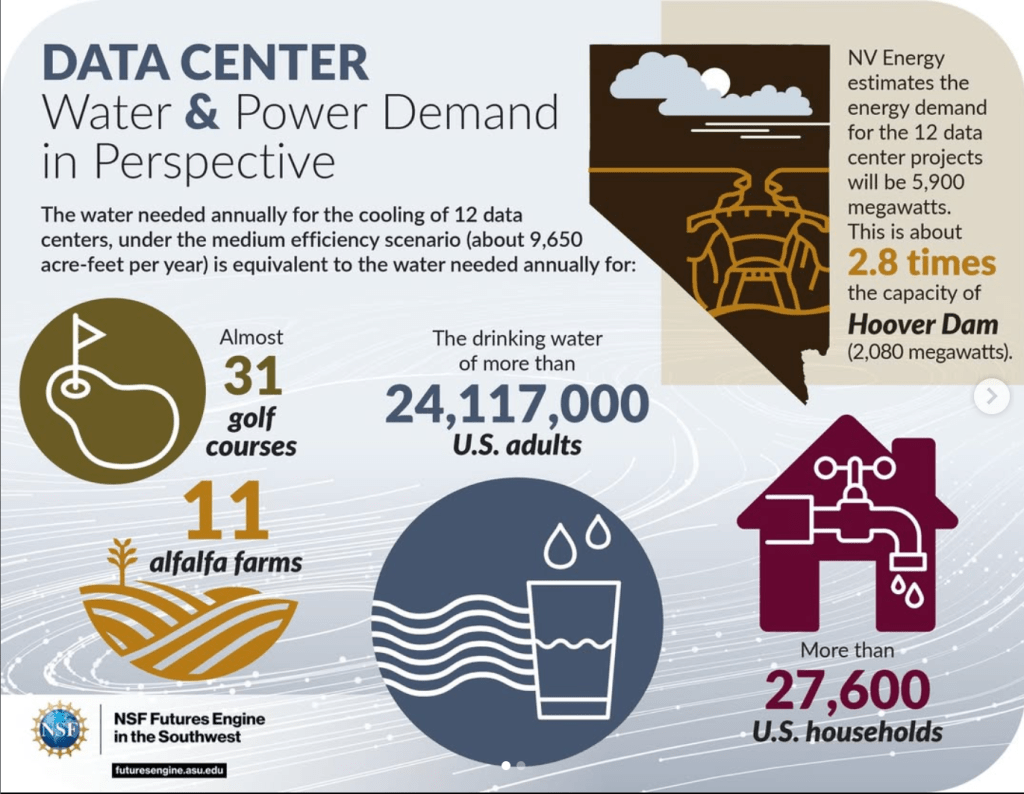
DRI’s report also found that just 12 proposed data center projects could require nearly 5,900 megawatts of power—that’s nearly three times the capacity of Hoover Dam.
To meet this growing electricity demand, the grid will require a new, upgraded infrastructure. That could take years to complete and a considerable capital investment.
If grid growth can’t keep up with demand, local communities could be exposed to power disruptions during heatwaves. Reno and Las Vegas are the fastest-warming cities in the nation. A summer power cut could put residents at risk of exposure to temperatures exceeding 100 degrees.
“Low-income families, seniors, and communities of color often bear the highest energy burden, paying a larger share of their income just to keep the lights on and their homes safe during Nevada’s extreme heat,” said Justin Hopson, an advocate and community organizer with Faith Organizing Alliance, in a statement.
“Energy equity is not just an environmental issue, it is an economic and moral one. Nevada’s regulators must prioritize affordable, clean energy solutions that put people first, not corporate profits or the growing demands of power-hungry data centers.”
Water? That’s a whole other challenge. Although water use by data centers varies according to their size and cooling method, DRI researchers estimate that just 12 facilities could consume nearly 12 billion liters of water annually by 2033.
That’s equivalent to the water use of roughly 31 golf courses a year. Or enough drinking water for more than 24 million adults.
As Nevada becomes a regional center for AI infrastructure, we face a critical challenge: balancing economic growth with the realities of limited water, rising energy demand, and a rapidly changing climate.
Part 1: Why is Nevada booming in data center development?
June 10, 2026
Nevada has become one of the fastest-growing data center markets in the western US. In the map above, you can see about 70 data centers scattered across the state. But why Nevada? Cheap land, relatively low taxes, low risk of natural disasters, and proximity to major markets like California.
The state also offers incentives, including 10- or 20-year tax abatements, which have played a significant role in this growth. To qualify for the abatements, though, companies must meet investment, employment, and wage requirements established by state law. Supporters argue these incentives help attract billions of dollars in private investment and strengthen Nevada’s position in the digital economy.
However, the rapid expansion of data centers—whether they provide storage for the cloud and other internet services or power artificial intelligence—has sparked growing public concerns about their enormous electricity and water consumption for cooling.
Critics also worry about environmental conservation, air pollution, strain on infrastructure, and whether communities are getting enough in return—like jobs—or just paying for something they don’t want.
In Reno, residents and environmental advocates got a major win last month after the City Council approved a pause on any new data center construction applications while stronger regulations are being debated.
Boulder City residents also pushed back when an AI-focused data center was proposed. Public pressure ultimately led Boulder City’s Planning Commission to reject the proposal last month.
Data centers are growing fast in Nevada, but so is the pushback. I’m digging into what that growth means for the state, who benefits, and what communities are being asked to give up in return.
The Server State is a newsletter-exclusive mini-series that will be updated weekly. Follow along here as we track data centers across the state and what it means for all of us who call Nevada home.