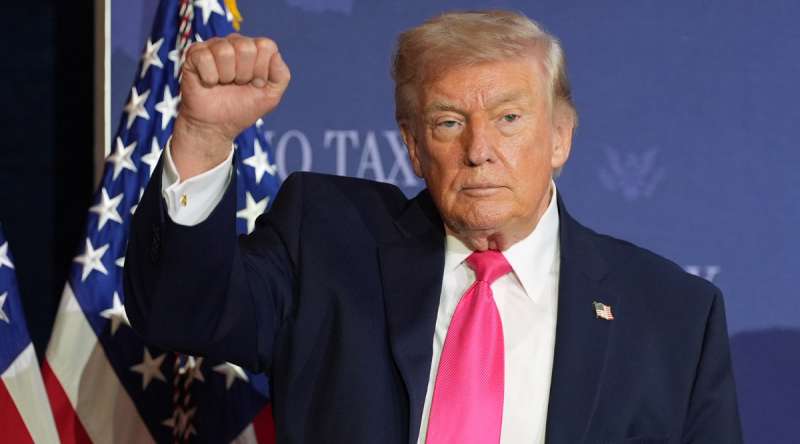
President Donald Trump will visit Las Vegas on Wednesday, Aug. 5 at the Red Rock Casino, Resort and Spa to tout how his tax policies have benefited Nevadans.
It will be his second Nevada visit this year as he also touted the administration’s tax cuts during an April stop at the AC Hotel in Las Vegas’ Symphony Park.
Marty O’Donnell, the Republican nominee for the 3rd Congressional District—the most competitive district in the state—is expected to attend the event.
It comes as state Democrats are vying to flip Nevada from red to blue again, and have championed affordability at the forefront of their campaigns ahead of the midterm elections.
Trump’s tax policies
Since Trump’s second term, his administration has enacted three major tax-related shifts: tariffs (later ruled unconstitutional by the Supreme Court), the One Big Beautiful Bill Act, and the termination of the Enhanced Premium Tax Credit, which helped millions of people afford health care.
The Institute on Taxation and Economic Policy reported that the combined impact of these policies is a tax increase for the average American, except for the wealthiest 5%. Working-class families are paying between $500 to $1,000 more in taxes since these policies went into effect.
Despite Trump coming to Las Vegas to “highlight how his working families tax cuts are delivering real results for American workers,” Vincent Nava, a working class Nevadan, said that though he lives in a dual-income household, it’s “still hard to make ends meet.”
“Our bills are higher than ever,” Nava said at a presser for Attorney General Aaron Ford. “Just last month, our bills were hundreds of dollars more expensive than they were a couple years back. It’s not getting easier.”
He added he’s working hard to make ends meet, but under the “Lombardo-Trump economy” — a term coined by state Democrats to highlight the affordability crisis — paying bills is a “bigger struggle than ever.”
Direct impacts to Nevada
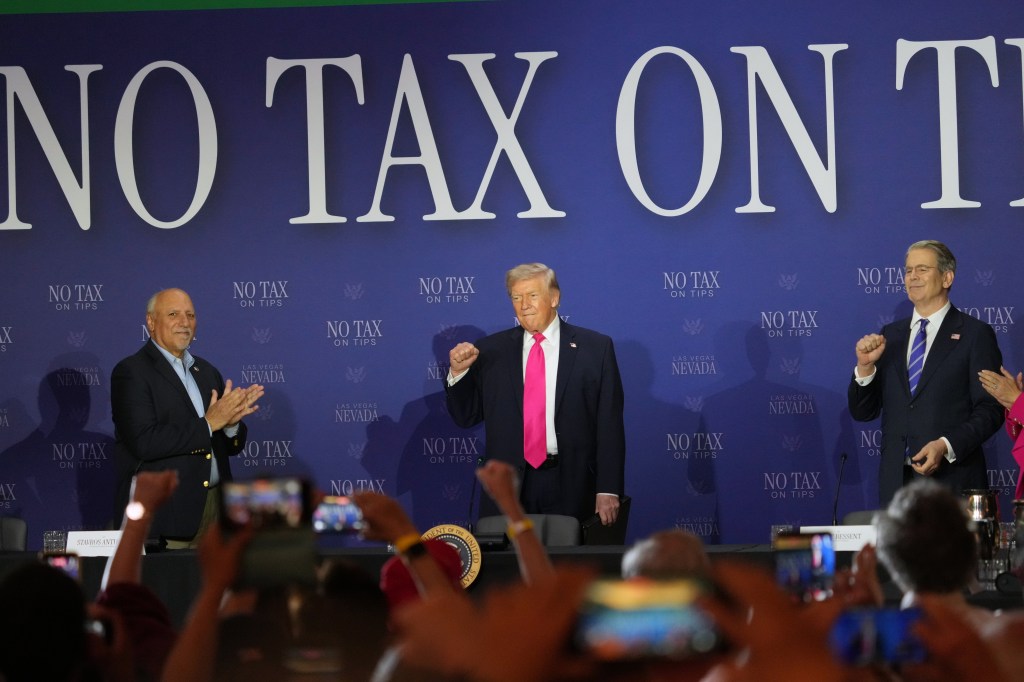
Trump largely won the Silver State in 2024 by rallying the working class and Latino community around his “no tax on tips” policy, as Nevada is heavily reliant on its tourism industry.
Tourism, however, has slumped in the once booming city since Trump took office in 2025—with a 7.5% visitor decline in 2025 compared to 2024—after he immediately enacted tariffs and aggressive immigration raids. He’s also rattled international travelers by poking at Canada and Greenland to become the country’s “51st state.”
Despite the no tax on tips policy, the Economic Policy Institute reports employers of tipped workers are the biggest beneficiaries to the policy rather than the actual employees. The institute also warns the policy undermines efforts to raise minimum wages and that it does not address low wages, income instability and wage theft.
Nevada’s minimum wage is $12 an hour.
Tipped workers and small businesses say that business has waned in the last year, and the visitors who do visit are tipping less. The working class is also being squeezed out of Las Vegas, as the luxury resorts are doing “exceptionally well,” whereas the more budget-friendly hotels are missing the working class visitors.
State Republicans have rallied behind Trump’s tax policies. Nevada Gov. Joe Lombardo, however, admitted he’s not sure how tariffs “directly affect Nevada” but that “we need to maybe feel a little pain in the short term, and hopefully in the long term, it [tariffs] will be a huge benefit.”
The U.S. Supreme Court ruled the tariffs unconstitutional earlier in February but under the refund process, companies — not consumers — became eligible to claim the money back. While consumers bore the brunt of tariffs racking up prices for common goods, corporations such as Apple, reported a $2.2 billion refund, and Amazon reported about a $600 million refund in the second quarter.
Nava, who’s also a parent to a one-year-old, said the prices of groceries, childcare, and bills are “becoming more unsustainable” under the “Lombardo-Trump economy.”
“Everything’s just going up, and it’s becoming more and more expensive. That’s what gets me mad,” Nava said. “Working class families, we deserve a break. We show up for our families, we show up for our communities, every part of life. We need someone to cut us a break.”