Most Nevadans can name their governor and local representatives, but many would be hard-pressed to name the three commissioners deciding their utility bill rates and how they’re calculated.
Yet the Nevada Public Utilities Commission is at the center of major changes around NV Energy customers’ energy bills, which are set to change for Southern Nevada customers come January 2027.
That is, unless appeals filed by the state attorney general and green energy groups succeed first.
Earlier this year, the commission announced a new peak demand charge, which will bill electric customers based on the highest 15 minutes of usage each day. Demand charges are common for businesses, but utilities that use them typically bill based on a single peak, which is the highest 15-minute window in a whole month. NV Energy’s version resets daily, meaning customers would need to manage their usage around a new peak each day rather than once a month.
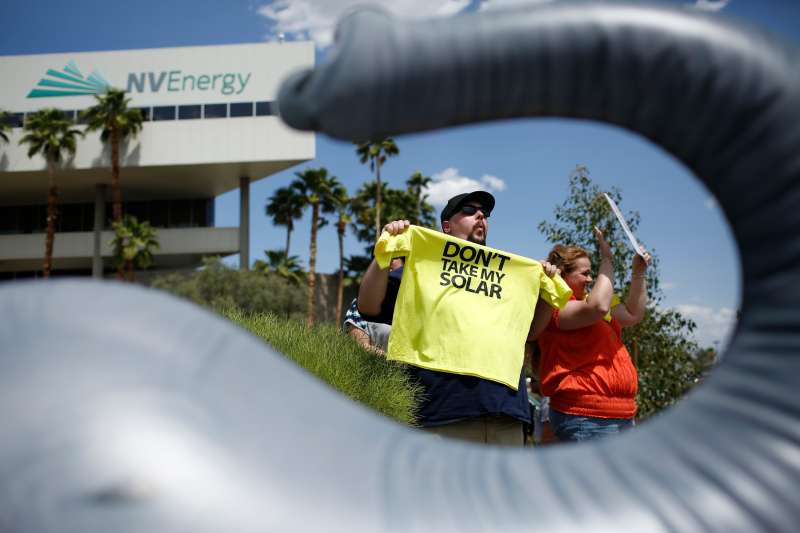
It’s a system that some experts say penalizes solar customers while introducing an overly complicated equation the average customer can’t easily use to predict their monthly bills. And, some say it could be illegal.
“At this point, we are waiting for the Nevada Supreme Court to make a decision about this,” said Jackie Spicer of the Nevada Environmental Justice Coalition.
The commission approved the rate change despite complaints from green energy organizers about how June’s public meetings were held.
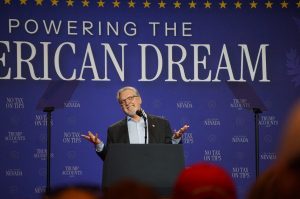
It’s all happening against the backdrop of a November governor’s race in the state that pits incumbent Joe Lombardo against current Attorney General Aaron Ford. Lombardo is getting donations from NV Energy and has said little about the rate change, while Ford is actively pursuing an appeal of the rate change in the state’s highest court.
How the commission works
The Nevada Public Utilities Commission, or PUC, is composed of three commissioners, each appointed by the governor.
Lombardo is a Republican whose energy policies over the years have supported an expansion into renewables, though not at the pace many clean energy advocates want. Like President Donald Trump, he wants to see fossil fuels in the mix, with an eye on supporting the state’s growing energy needs from a variety of sources. That’s despite Nevada being home to the country’s two fastest-warming cities: Reno and Las Vegas.
And money talks. Lombardo received some of the highest donations to any candidate for office in 2025 and 2026 made by NV Energy and Southwest Gas, about $40,000 between the two utilities.
Lombardo has had a hand in reappointing each of the three commissioners on the PUC. First appointed by Democratic Gov. Steve Sisolak in 2020, Chair of the Commission Hayley Williamson was reappointed by Gov. Joe Lombardo in 2023. Commissioner Tammy Cordova was also first appointed in 2020 by Sisolak and reappointed in 2024 by Lombardo. Finally, Commissioner Randy J. Brown was first appointed to the commission by Lombardo in 2023 and reappointed in 2025.
While Lombardo isn’t setting utility rates for Nevadans, he wields power over those who do.
“The governor may not have the explicit veto power the way he does over legislation, but he does have authority to change the makeup, and there are other things that can be done,” Spicer said.
What’s behind the new peak demand charge
NV Energy says the peak demand charge will effectively lower as many as 90% of customers’ bills. They also said they’re implementing it to properly charge solar customers who aren’t otherwise paying to upkeep the grid’s infrastructure.
Nevada Attorney General Aaron Ford said the new rate unfairly charges solar customers and was approved by the commission unlawfully.
Spicer said that while NV Energy claims this new rate will lower bills for the vast majority of customers, many are skeptical.
“People with high energy burdens tend to live in older homes, homes with older appliances that don’t work as efficiently. They’re folks who have to run the AC more because they may live in an urban heat island in the urban core, which has measurably higher temperatures,” Spicer said. “So we see a lot of intersections between extreme heat and energy burdens in Nevada.”
Brad Heusinkveld, regulatory director for the national nonprofit Vote Solar, said that while NV Energy claims this will help customers, there’s no proof yet that it will.
“As a matter of policy, what the commission is saying with respect to the average customer may be true, but there is no average customer. The average customer is a figment of a mathematical equation,” he said.
Major corporations and businesses that employ energy-saving software for this very purpose could see their charges drop, Heusinkveld adds, but those aren’t average Nevadans.
“What the demand charge is going to do is introduce a lot more variability to residential customers, and it’s hard for the vast majority of people to manage their own usage with the granularity that this requires to save money,” he said.
How the formula was approved
As the regulatory agency for the state’s utilities, the commission is tasked with reviewing and approving proposals like the one brought forth last year by NV Energy, which included the new rate formula as part of a $119 million rate hike application.
Usually, the commission holds a series of town hall-style meetings where residents can voice their concerns in person. This year, clean energy advocates criticized the commission for canceling one of two consumer sessions held in Las Vegas, leaving only a mid-afternoon session that many working residents couldn’t attend. Spicer said the commission responded to criticism of this schedule by saying they aren’t required to provide an additional evening session.
“We do want to see greater accessibility at the Public Utilities Commission, but we’ve been asking for that since before this consumer session happened,” Spicer said, adding that the coalition has asked for virtual viewing, commenting options, and interpreters for residents who don’t speak English.
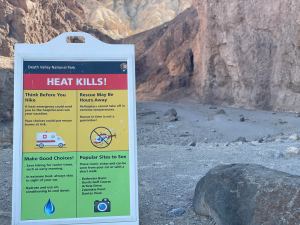
On top of that, the commission didn’t make overflow rooms available for residents who showed up to speak, instead forcing them to wait outside the air-conditioned building in record-high temperatures where they provided bottled water. Those who waited in a long line that snaked around the building had nowhere to sit and no bathrooms to use during the hours-long wait.
“We as a coalition are aware of the dangers of extreme heat to people’s health, especially,” Spicer said of the temperature that day.
Angel DeFazio, who has attended PUC consumer sessions for 16 years, told the Nevada Current the commission had never before kept attendees waiting outside, admitting them only as speakers left—a setup she said was meant to discourage public participation.
The community meetings were held after the PUC decided in March to delay implementation of the new rate until January 2027, saying they needed to better communicate with customers on how the changes would affect their bills. NV Energy was also busy issuing refunds to customers after it was caught overcharging them to the tune of $63 million since 2002, but that’s a separate issue.
What happens next?
Two appeals for the rate change are in process in the state, and both were rejected. In late May, a Clark County judge denied a petition for judicial review filed by the Attorney General’s Bureau of Consumer Protection. A day later, a Carson City judge denied a similar petition from Vote Solar. Both are now appealing to the Nevada Supreme Court.
Heusinkveld said Vote Solar’s appeal has less to do with NV Energy’s intent than state statute, which “prohibits a time-varied rate,” he said. Vote Solar contends this peak usage time block falls into that category.
There’s no timeline for when these appeals will be heard, Heusinkveld said, but if nothing happens before Jan. 1, that’s when the new rate formula will go into effect.