The federal government gave $99 million to help build a state-of-the-art water recycling facility planned to open in 2032. Officials hope it will lessen California’s reliance on the Colorado River, thus helping Nevada.
California officials moving to build the largest water recycling facility in the US got a welcome boost last month after the project was approved for a nearly $100 million federal grant.
The Metropolitan Water District of Southern California was awarded $99.2 million in funding from the Bipartisan Infrastructure Law to aid in the construction of the Pure Water Southern California project — a planned full-scale regional water recycling facility in the Los Angeles suburb of Carson. Officials say once fully operational the project will be able to produce up to 150 million gallons of purified water daily — enough to supply up to 500,000 homes.
Among those who celebrated the May 28 funding announcement was US Sen. Catherine Cortez Masto (D-Nevada), who said in a statement that despite the project’s intentions to help residents in Southern California, it will also help Nevada by reducing California’s reliance on the Colorado River as a source for drinking water.
“Addressing drought in the West and protecting Nevada’s water supply will require all of us to work together on innovative, sustainable solutions,” Cortez Masto said in a release announcing the funding, adding the project will help combat drought and help keep water in Lake Mead.
Nevada and California are part of a group of seven Western US states that, along with Mexico, rely on the Colorado River for water. The Colorado River Basin itself is split into an upper region consisting of Wyoming, Colorado, Utah, and New Mexico, while Nevada, California, and Arizona are defined as lower basin states. The river flows into two reservoirs, Lake Powell and Lake Mead, and provides water for roughly 40 million Americans.
MORE: Nevada to get $9M in federal grants for water projects
Under current guidelines, the three lower basin states are allocated a cumulative 7.5 million acre-feet of river water per year, with California allotted 58.7% of that amount. Arizona is allowed the second-most 37.3%, while Nevada’s annual allowance is just 4% of the overall allocation.
But a historic decades-long drought has caused water levels in Lakes Mead and Powell to plummet in recent years, triggering mandatory conservation measures that still may require further voluntary cuts if water levels continue to fall.
“These are significant and serious reductions,” Bill Hasencamp, the manager of Colorado River Resources for Metropolitan Water, told The Nevadan. State and federal officials have scrambled in recent years to come up with solutions to ensure the Colorado River has enough water to keep up with demand, and the Pure Water project hopes to be one such long-term answer.
What’s the big deal?
At its core, the Pure Water project aims to reclaim and purify wastewater that today is dumped into the Pacific Ocean.
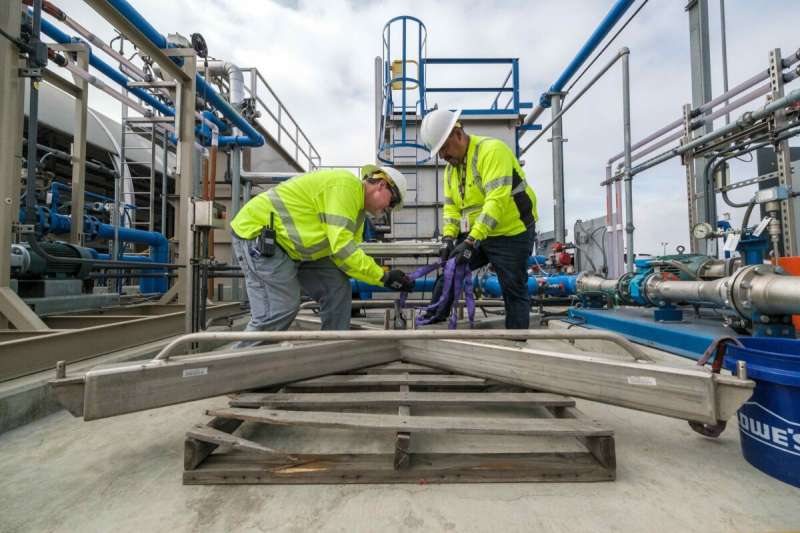
Hasencamp said the plant will use an innovative three-step process that will purify wastewater and inject it back into local aquifers to be used again. Along with purification processes called reverse osmosis, ultraviolet disinfection, and advanced oxidation, the project will deploy the use of so-called membrane bioreactors, or MBRs, in which air is added to tanks filled with microorganisms.
According to the project’s website, the microorganisms help remove organic materials such as ammonia and nitrates from the treated water, before it then flows through tanks where thousands of straw-shaped membranes filter out the microscopic organisms and other materials smaller than 1/100 of a grain of sand. MBR technology has been used for decades in the wastewater industry but its application for water purification is relatively new.
“The biggest challenge for us isn’t the technology to clean it up,” Hasencamp said. “The bigger problem is that the water that is treated is down by the ocean, and it’s hard for us to use it. So we need to put it back in our distribution system, which means we have to have pumps and pipelines 20, 30 miles long that go back upstream so we can go back into our water treatment and distribution system.”
In 2019, Southern California officials opened the Grace F. Napolitano Innovation Center — a scaled-down version of what officials hope the final Pure Water project will become. That facility is able to produce 500,000 gallons of purified water daily and was constructed to collect data about the MBR filtration process to show regulators for wider approval.
The treated water has to meet or exceed the state’s stringent drinking water standards before it is pumped upwards of 60 miles using a network of pipes and finally returned to local groundwater basins or industrial facilities.
While its a first-of-its kind project, it still is just one of the many tools California officials are using to lessen the state’s dependence on the Colorado River, Hasencamp said.
“Pure Water is the biggest, but it’s not the only one, and there’s more to do,” Hasencamp said. “I think the lower basin is on the same page that the [rate of] use we have been using is not sustainable.”
Nevada’s role in Pure Water
Bronson Mack, an outreach manager for the Southern Nevada Water Authority, told The Nevadan that the agency is giving approximately $750 million to help fund the Pure Water project, which is currently undergoing regulatory approvals. The project is tentatively scheduled to have facilities online by 2028 and be fully operational by 2032.
Those SNWA funds, Mack said, will largely help fund the environmental impact analysis needed before the project can move forward as well as engineering assessments.
In exchange for Nevada’s financial contribution, Mack said, California will leave some of its allocated Colorado River water in Lake Mead for Nevada’s use, if needed, which will help extend the water supply and allow officials to maximize use of water resources.
“It’s going to enhance water supply resilience, because now you’ve essentially got a new source of water,” Mack said. “This is wastewater that usually is discharged into the Pacific Ocean where it can’t be used again.”
Although the outlook on water levels is somewhat uncertain, Mack said the SNWA is able to use population predictions published by the University of Nevada, Las Vegas, to forecast the valley’s water needs for up to a 50-year window, and that SNWA doesn’t foresee any municipal use shortages on the horizon.
“We always know what our water use is and where our water use may go, and what water resources we need to meet that demand in the future,” Mack said. “Not just in the future, but over the next half-century.”
Federal resources pouring in
The US Department of the Interior also announced Thursday an additional $700 million intended for water conservation projects across the Lower Colorado River Basin. According to a news release the funding will go toward water distribution structures, advanced metering infrastructure, agriculture efficiency improvements, groundwater banking, desalination, and other conservation methods.
“The Biden-Harris administration is committed to making western communities more resilient to the impacts of climate change,” Interior Secretary Deb Haaland said in a statement. “Building on our significant efforts to protect the Colorado River System, we are continuing to make smart investments through the President’s Investing in America agenda to strengthen the stability and sustainability of the Colorado River System and support the 40 million people who rely on this basin now and into the future.”
In December, the Biden administration also granted $295 million in infrastructure funds to the Golden State to conserve an additional 643,000 acre-feet of Lake Mead water through 2025. California, Nevada and Arizona agreed last May to conserve a cumulative 3 million acre-feet through the end of 2026.
Some efforts appear to be working to some degree, Hasencamp said. Between reductions that have already taken place and snowier-than-average winters in 2022 and 2023, Lake Mead’s water level is now at about 1,066 feet — about 35 feet higher than it was at its lowest point in July 2022, though is still several hundred feet from its record-high of 1,225 feet set in 1983.
It also helps that the federal government has subsidized most of those voluntary cutbacks, Hasencamp added. Once federal funds run dry, states may be more reluctant to make their own cuts – but current guidelines are at least a good starting point until all seven Colorado River states can come to a better consensus on the river’s long-term future, Hasencamp said.