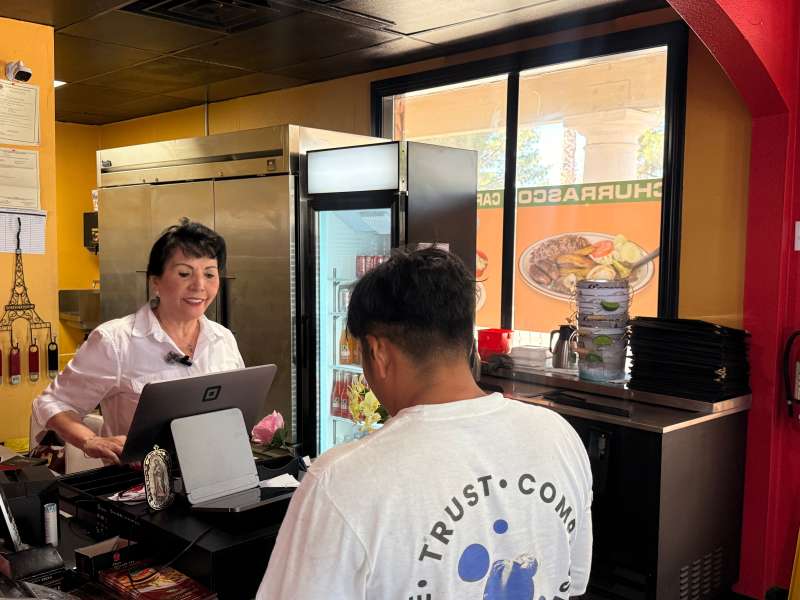
She has been a small business owner for 31 years, but as of last year, Daisy Vega felt the direct impacts from the Trump administration’s policies trickling down into her business endeavors for the first time in her life.
Vega, owner of Esmeraldas Restaurante, opened her first cafe in 1995. Esmeraldas Restaurante marks the fifth business Vega has owned, but with one caveat. She opened her restaurant last year—and she’s already struggling to make ends meet with the crippling economy.
“People don’t go out as much as they did before. But I’ve been doing this business for 31 years, and this is the first time since I opened that this has impacted me this much,” Vega told The Nevadan. “We’re kind of struggling, but we keep on going, hoping that things will be better.”
Vega attributes her struggling business to tariffs, immigration, and consumers paring back on their spending.
She remembers when ranchera meat—a marbled cut of beef from the bottom of a sirloin—used to cost $5 per pound. Now, she pays $15.99.
According to the Federal Reserve Bank of St. Louis, beef steak and ground beef prices soared up to 16% compared to last year. In May, the average price of ground beef was $6.74 per pound. Beef steak was nearly $13 per pound.
Vega told The Nevadan that her suppliers attributed the rise of costs directly to tariffs. She hasn’t raised her prices just yet, meaning she’s been eating the cost so it doesn’t get passed down to the consumer.
She noted, however, that for her previous businesses, she would only charge $1.50 for a pupusa. Now, she charges $3.
‘Everything is just against us’
Because of her struggling business, Vega has a small team of three that helps run the restaurant. She works seven days a week, and she hopes to hire more staff eventually, but can’t until her business becomes more profitable.
She’s also noticed that her regular clientele doesn’t visit the restaurant as often either.
“ People used to come once a week. Now they come every two [to] three weeks, or maybe even once a month,” Vega said. “So, the economy has really had an impact on the small restaurants.”
There’s another batch of customers that she doesn’t see anymore—and she attributes her missing regulars to federal immigration policies.
“That really got the business down because most of my customers were Hispanics … And they stopped coming because they stopped working,” Vega said. “They got fired from their jobs, and a lot of people got deported, so I lost a lot of customers that way.”
This is a trend that’s happening across the country.
According to the University of Colorado research, employment among undocumented immigrants in regions that experienced an Immigration and Customs Enforcement (ICE) surge fell 4%. For the first half of 2025, about 1.2 million immigrants vanished from the workforce, according to an analysis by the Pew Research Center.
“ They’re afraid as customers. Now they’re afraid to go out or they lost their jobs,” Vega said. “Everything is just against us right now.”
The Latino vote
In 2024, Latino voters helped swing the presidential election. President Donald Trump won 35% of the state’s Latino vote, marking it as about a 10% increase from 2020. In 2016 when Trump first ran, he received 16% of the Latino vote. The most important issue for Latino voters in 2024 was inflation and the cost of living.
This issue is still at the top of mind for Vega two years later.
Despite Latinos in the Silver State turning to the conservative vote, Vega feels federal policies haven’t helped her business. Similarly, she hasn’t felt supported by statewide officials either.
“We’re still struggling here. The economy is bad,” Vega said. “It’s not helping my business at all.”
With the general election approaching in November, she hopes there will be new elected leadership. Vega especially hopes Nevada will elect a new governor: Attorney General Aaron Ford (D). She added that Republican Gov. Joe Lombardo hasn’t helped offset the federal economic impacts affecting her business.
When asked about tariffs at the beginning of 2025, Lombardo said, “I think we need to maybe feel a little pain in the short term and, hopefully in the long term, it’s a huge benefit for us.”
In an interview with The Nevadan, Ford pointed out Vega is someone who’s still feeling the “pain” from those tariffs—and in February, the Supreme Court ruled Trump’s tariffs unconstitutional.
Ford told The Nevadan that to secure the Latino vote in the upcoming election, he’s been out in the community talking with families and small business owners. He’s learned many Nevadans “just want a good job, to buy a house in a safe neighborhood, where the schools are preparing their kids for careers after college.”
“And through all of that, [they want] to be treated with humanity, dignity, and respect,” Ford added. “The Latino community deserves that in elected leaders and a leader who’s going to look out for them [and] who considers them part of the Nevada family. That’s not what we have in Joe Lombardo.”