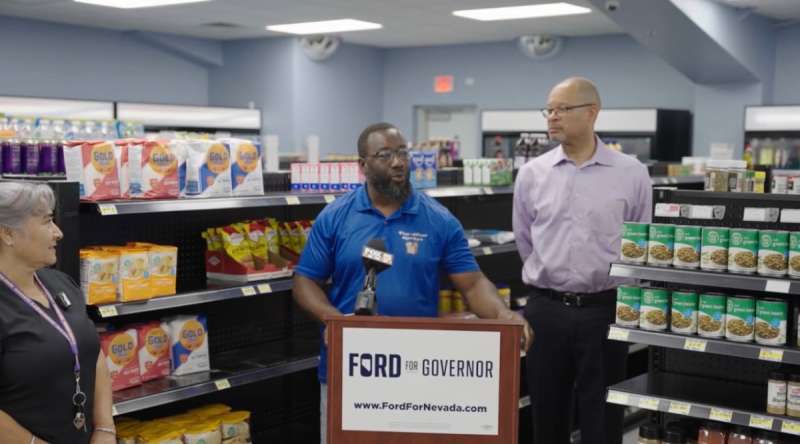
When DeWayne McCoy opened the After Market, a hybrid grocery store and food pantry in North Las Vegas, he hoped retail sales would help sustain the free side. But since President Donald Trump’s tax and spending law—known as the One Big Beautiful Bill Act—took effect, he fears that model won’t survive.
McCoy calls it a “big beautiful mess” for Nevadans and for the After Market’s mission. The law added strict new work requirements to qualify for the Supplemental Nutrition Assistance Program (SNAP), narrowing who’s eligible for the federal food assistance program.
The fallout isn’t only national. Nevada, with its heavy blue-collar, tourism-dependent economy, is feeling it more than most states.
Fewer shoppers, more mouths to feed
In the past year, the After Market’s food pantry has served about 4,300 households — 2,500 of them new — meaning they’d never relied on food assistance before. McCoy attributes the growing demand to impacts of the bill, which has kicked off nearly 70,000 Nevadans off of SNAP.
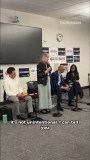
“We are in the process of serving as many people as we can on a daily basis, anywhere between 150 to about 200 people a day,” McCoy said at an event for Democratic gubernatorial nominee Aaron Ford. “Unfortunately with all of the changes, our retail side, which is our sustainability piece, has dropped dramatically.”
Grocery sales have dropped about 40% in the past year, McCoy said, while pantry-use has climbed as much as 45%. In result, he’s had to furlough four employees to offset the loss of revenue.
More Nevadans are expected to lose access to SNAP as work requirements roll out.
The Silver State is at risk of owing the federal government nearly $44 million dollars due to its 6.22% error rate, a measure of how accurately the state calculates SNAP eligibility and benefit amounts. In 2025, the average Nevadan on SNAP received $171 a month.
The Nevada Division of Social Services (DSS) intends to lower the state’s error rate for fiscal year 2026 to avoid that penalty — a fix that could mean hiring freezes, a smaller agency workforce, and tighter restrictions on who qualifies for SNAP.
“We are serving about 240 additional households that we’ve never seen, every single month, and it keeps going up and up,” McCoy said. “ It has become so heavy upon us as an organization, we’re almost paying to provide the service … something has to change [with] leadership, something has to change with the governor, so that people can get what they need.”
Health care workers feel the squeeze too
Nationally, most people with SNAP benefits are also enrolled in Medicaid, according to KFF — which has also been impacted by the Big Beautiful Bill.
Since the law took effect, about 8,000 Nevadans have lost affordable health coverage, and more than 147,000 residents are expected to be affected by new work requirements, narrower eligibility for immigrants, and higher co-pays beginning in 2027.
Of that group, Nevada Medicaid administrator Ann Jensen expects 70,000 Nevadans to lose coverage all together — pushing the state’s uninsured population to nearly 500,000 people.
That worries Irma Luz Lopez, a home healthcare provider in Las Vegas.
At Ford’s event, Lopez told reporters that more than 3,000 home healthcare workers are “scared” because they’re losing hours and benefits as clients get denied coverage. She said the strain has spread to hospital nurses too, who she believes are losing hours as more Nevadans lose health coverage — leaving clinics feeling increasingly empty.
“When I’m talking to nurses … they say that now they have to do the job [of] two nurses because they have less hours,” Lopez, who’s also part of the SEIU Local 1107 union, said in an interview.
Before the interview, Lopez took one of her clients—who was actually denied coverage but Lopez helped anyway— to a clinic, and she said it too was empty, a trend she’s noticed for a year now.
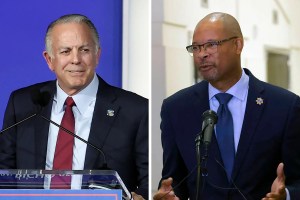
Both McCoy and Lopez said they’re hoping for leadership change come November, and both point to Ford as the candidate they believe will ease the burden on Nevadans.