A reader recently sent The Nevadan a question about one of the hottest places on Earth: Why doesn’t Death Valley National Park close to the public during extreme temperatures to prevent heat-related injuries and deaths?
It’s a fair question. Summer temperatures in Death Valley can climb above 120 degrees. Surprisingly, August is often the second busiest month for Death Valley National Park.
Other Nevada recreation areas take a different approach. Valley of Fire State Park and Lake Mead National Recreation Area close certain trails during the summer when visitors could become stranded or difficult to rescue.
So why does Death Valley stay open in extreme conditions?
“You can’t answer that question in one word,” said Abby Wines, deputy superintendent of Death Valley National Park, who has worked in the area for 31 years. “No death is acceptable. No preventable death is acceptable.”
But it does happen, Wines said. On average, between one and three people die in Death Valley during most summers from heat-related causes, she added. The deaths happen in different places, from trails to developed areas.
“No one died last summer due to heat, and so far this summer we’re also batting zero, which is great,” Wines said.
The park’s strategy, she said, is largely prevention: educate visitors, warn them about the conditions and encourage them to limit their exposure to the heat.
“And while not 100% effective, because that does mean that people are making their own decision rather than us saying, ‘You cannot do this,’ it seems to mostly work well,” Wines said.
Read up on how to stay safe when visiting Death Valley in the summer.
The park’s warnings are everywhere
During summer, visitors entering Death Valley encounter signs warning of the extreme heat. The visitor center has additional information, and rangers talk to visitors about staying safe.
But Wines said some of the most effective warnings are at trailheads.
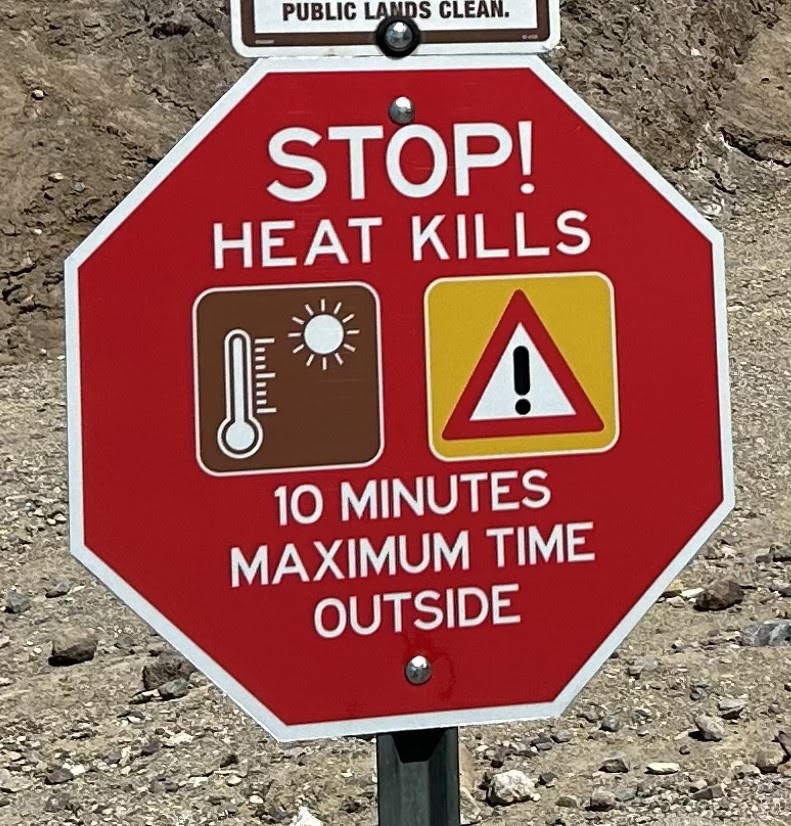
At Golden Canyon, one of the park’s most popular trails, visitors encounter a red stop sign warning that reads “Stop! Heat kills. 10 minutes maximum time outside.”
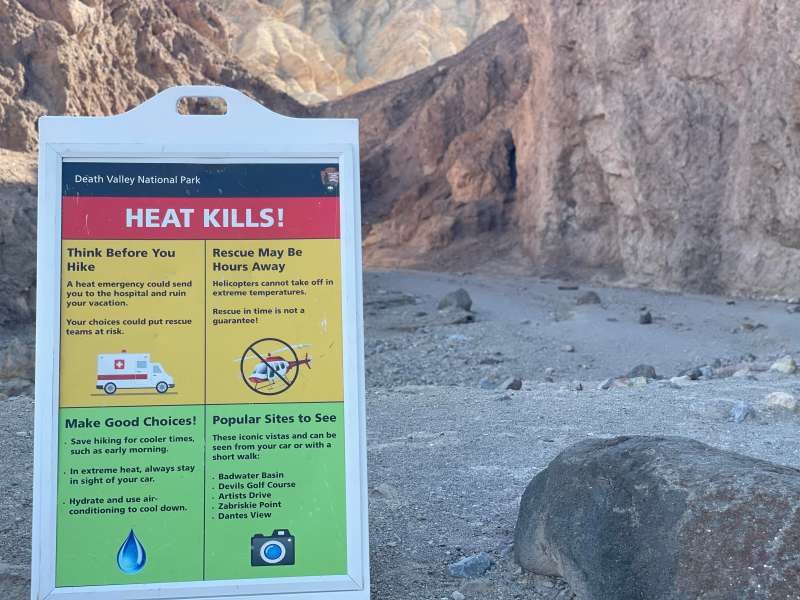
The park also uses temporary A-frame signs with pictures of an ambulance and a helicopter letting hikers know rescue efforts may be limited, or not achievable at all.
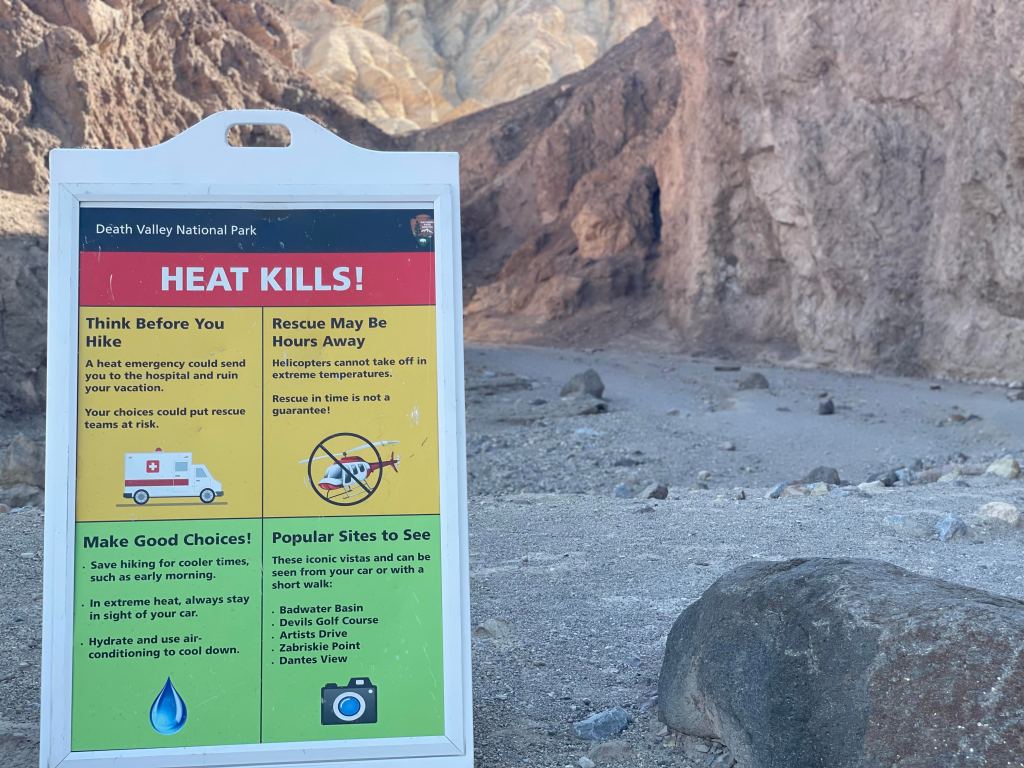
“We tell people that we cannot rescue you when it’s hot,” Wines said.
Extreme temperatures can prevent medical helicopters from flying safely because the hot air provides less lift. And if a helicopter cannot fly, sending rangers into the heat to carry someone out can put them at risk.
“So if it’s too hot for a helicopter to fly, it will also be too hot for us to hike down this trail with a litter, pick you up, and take you back,” Wines said. “That would be more time than I and my coworkers can safely be exposed to the heat.”
Why not close the trails?
Wines said there are also practical reasons the park doesn’t simply close or limit access to certain spots like Lake Mead.
Lake Mead, she noted, closes some trails because their design can create a particular hazard: visitors hike downhill in the morning and then have to climb back up during the hottest part of the day.
“That just becomes a trap for people,” she said.
It is possible to experience Death Valley without spending hours under the blazing sun. Visitors can drive between viewpoints, get out briefly and return to an air-conditioned vehicle.
And people are coming specifically to experience the extreme conditions.
Wines said about 70% of the park’s visitors in the summer months are international travelers. Many make Death Valley a quick stop while traveling between Las Vegas and Yosemite National Park.
“They want to experience the American West. The most extreme part of the American West, the hottest part of the American West is Death Valley,” she said. “On average, 300,000 people come here every summer, and most of them have a wonderful time and are completely safe.”
A five-minute walk, a photo by the thermometer and a quick return to the car can make for a safe summer visit, she said.
Don’t try to tough it out
“The biggest mistake is thinking that it’s mind over matter,” Wines said. “ Thinking, ‘Oh, I’m tough because I’m an athlete,’ or, ‘I’m tough because I’m young,’ or, ‘I’m tough because I live in a hot place.’ Whatever the reason is. Trying to macho their way through it.”
But even more “moderate” temperatures can be deceptive, she said.
When temperatures reach 124 degrees, Wines said, most people step out of their cars, realize how hot it is and quickly return to the air conditioning.
But between 100 and 105 degrees, the dry air can make conditions feel more tolerable than they really are and visitors might feel like it’s a “reasonable time to go for a hike,” she said.
Park rangers respond to overheated visitors several times a week during the summer. Most often, visitors make it to the visitor center, where rangers can give them water, check their vital signs and help them cool down.
The park’s strongest summer message is simple: limit your time in the heat.
Respect the heat—and the park
Death Valley employees follow that advice themselves.
Wines said park housing generally has both air conditioning and evaporative coolers, and employees stay indoors during the hottest parts of the day. Exercise is done early in the morning. And take notes from the Timbisha Shoshone who lived in the area for thousands of years, Wines said.
“ The Timbisha Shoshone, this is their homeland, and they adapted in an entirely different way, which honestly is smarter. They would move with the seasons. So they would spend the winters down here in the Furnace Creek, the valley floor, and then move up into the mountains in the summertime. And it’s much cooler up there,” she explained that even the Park Service used to do that when Death Valley became established as a national monument first in 1933.
“Park Service would close up shop down here and move up to Wildrose, up to 5,000 feet in the summertime, and then move down to the lower part of the park in the winter,” she said. “But as electricity became more reliable, it became an option to live here year-round, and now we’re dependent upon our technology.”
For visitors, Wines recommends coming in winter if they want to hike and truly explore the park.
But summer visitors can still safely experience Death Valley if they understand the environment, pay attention to their body and warning signs of overheating, keep their time outside short, simply drive by, or take advantage of the “cooler” temperatures during sunrise and sunset.
So to answer the reader’s question: Death Valley stays open because park officials believe visitors can experience its extraordinary landscape while managing extreme heat danger.
“I wish people knew just how spectacular Death Valley is,” Wines said. “And take it seriously. National parks are not Disneyland. They are natural environments, and so you need to respect the hazards that exist in those environments.”