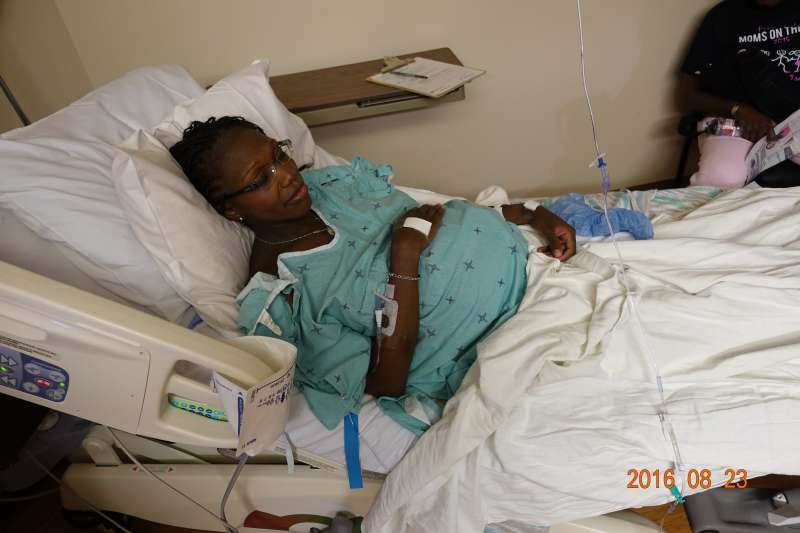
Dr. Bayo Curry-Winchell is a family physician and the medical director for Saint Mary’s Urgent Care Group in Reno. She shared her story with The Nevadan writer Bonnie Fuller in hopes of helping others.
I was 38 and had just delivered my second baby, a little girl, at the Reno hospital where I was a medical director at the time.
I had to have a C-section, because I have an autoimmune disorder called lupus and an autoimmune blood clotting disorder, antiphospholipid syndrome, both of which can cause pregnancy complications.
I remember holding my new daughter in the recovery room and then being wheeled into my hospital room. That’s when I started feeling like something wasn’t right. I didn’t feel like myself. I was having a hard time talking and I was in a lot of pain.
I had given birth to my older daughter, Jordan, just two years before. Two years isn’t that long, and I could remember how I felt after giving birth to her by C-section, and this was not it.
I kept pressing the call button on my bed to have the nurse come in. I told her that something was wrong at least three to four times. She would come into my room, check my blood pressure and other vital signs, and then say, “Nope.”
I remember that she came up close, looking at my face, and said that everything looked fine.
But it was getting hard for me to retrieve words. It was really difficult to concentrate. I could hear my husband talking, but I was having a hard time understanding him. I started to feel like I was having this weird out-of-body experience.
I wasn’t capable of using my medical training in that moment.
But I had to do something. I handed my phone to my husband, James, and told him to call my OB-GYN right away. After doing my C-section, my OB, Dr. Randall Jack, had headed back to his office, which was fortunately very close by.
“There’s something wrong with Bayo. Can you please come back?”
Dr. Jack believed him and came right back to the hospital.
I remember speaking with Dr. Jack and he said, “We’re going to figure this out, something’s wrong,” and then we were back in the OR and I was looking up at my anesthesiologist and he was saying, “We’re going to take care of you, Bayo.”
Even now, nine years later, the experience feels like yesterday. I remember feeling really afraid. I thought I was going to die. One hundred percent.
Then I went under as the general anesthesia took effect.
It turned out that I still had retained products, including placenta and fetal tissue, in my uterus. Unfortunately, this can happen sometimes, especially after a prior C-section.
I also was bleeding internally. I had lost so much blood, I had to have a transfusion.
‘I would have died if this had been my first delivery’
I later realized that if this had been my first pregnancy and C-section, I would definitely have died.
That’s because I would have believed the nurse who kept reassuring me that nothing was wrong. I would have bled to death because my uterus was trying to push the retained products out.
That’s what your womb does. It recognizes that there is a foreign body inside the uterus and it wants to expel it. Then a bacterial infection and sepsis can set in and at a certain threshold, it would have been too late for me to come back. For my life to be saved.
American Black women have a very high maternal mortality rate, and I lived it myself.
If my doctor had not believed my husband and me and returned to care for me, I would have been like other Black women you hear about passing away after giving birth.
Editor’s note: In 2024, the maternal mortality rate for Black American women was 44.8 per 100,000 live births. The rate for white American women was 14.2 and for Hispanic women, 12.1. Maternal mortality is defined as death during pregnancy, childbirth, and within 42 days, or six weeks, after the end of a pregnancy. Overall, American maternal mortality is the highest of all high-income countries.
Dr. Jack saved me, but I don’t remember even being in the hospital for the first two or three days after nearly dying—probably from losing so much blood.
Red blood cells carry oxygen to your brain, and if I lost a lot of blood, I lost the capacity to remember. I’ll never be able to get back those moments of first connecting to my daughter, Jaylin.
I don’t believe that what happened to me—the nurse not taking me seriously after I said something was wrong—was racism. But I do know that being a Black woman had to have been part of that equation.
I think there can be unconscious bias, and all of us have it. And that’s what happened in that moment. To her, I didn’t look like I was in pain or that something was wrong.
There has been this historical notion that Black women did not feel pain. That has carried over into the narrative of Black women not being believed.
The far-higher rate of maternal mortality for Black women spans across all incomes, including high incomes. If you are a pregnant Black woman in America, you are still more likely to lose your life than a white woman.
My nurse should have done more when I told her that something was wrong, even though her assessment was that I was OK.
She should have called my doctor, ordered blood tests—something to figure out why I was saying that there was a problem. After all, my medical history showed that I suffered from lupus and a clotting disorder.
A difficult first pregnancy
Also, I had experienced a serious complication after I gave birth to my first daughter. At that time, I developed a hematoma—a pocket of blood under my C-section incision—which kept getting bigger and more uncomfortable after I left the hospital.
When I went for my post-birth checkup a few days later, Dr. Jack was checking the incision and it just opened up and sprayed blood everywhere, even the ceiling.
My husband, James, who is 6-foot-5, passed out on the floor.
Fortunately, he got it together and got up off the floor because we had to immediately go to a specific hospital in Reno where they specialized in wound care.
I had to be tethered to a machine, which was connected to my C-section incision for two months, to help the incision heal.
During this first pregnancy, I had already been placed on bed rest because my lupus flared up. My doctor feared that I would go into labor too early.
I was in my third year of my family medicine residency at the time, and I couldn’t stay in bed, so I made a deal with my program director.
I would sit in a wheelchair as much as possible and would pedal or get pushed from room to room to see patients, including newborns in the nursery.
I didn’t want to compromise my baby in any way, so this was an out-of-the-box solution to my situation.
‘My dad is my inspiration’
Whenever I have a challenge, I credit my dad for inspiring me to find solutions.
My father served in three wars: World War II, the Korean War, and the Vietnam War. He served in a segregated unit in the Army in World War II. Then he joined the Air Force for the other two wars.
He died last year at 99 and was always so positive. He became a special education teacher for 26 years after retiring from the military. He would always say to me that health is one of your most prized possessions.
I agree and also believe that you should have autonomy in making your own healthcare decisions, including about your reproductive health.
Self-advocacy as a healthcare safeguard
After having my near-death experience after my concerns were dismissed, my goal is to help women in all health areas—whether it’s their reproductive health, heart health or gastrointestinal health.
Dismissal happens everywhere.
If I can give a woman, a patient, information that can help her advocate for herself—whether she’s Black, white, any race—that brings me joy.
My husband and I met in Spanish class at the University of Nevada, Reno. He’s an engineer and he’s been a partner in helping me with the advocacy work that I do. He really thought that he would lose me when I was wheeled back into the operating room after our second daughter was born.
He helped me set up Clinicians Who Care, a directory of physicians across the country and from every specialty who have been recommended by either myself or their patients because they have been caring and empathetic.
My advice for any woman who wants to make her pregnancy and childbirth as safe as possible is to interview your doctor before becoming their patient. You want to make sure your doctor will be in your corner.
Ask them: “If I were to face a complication, how would you deal with that?” Make sure that you feel that they listen to you like Dr. Jack listened to me.
Also, if you are giving birth, bring someone along who can advocate for you. And if you can’t bring someone physically, make sure that you have someone reachable on the phone who can advocate for you.
Today, I still wonder about what would have happened if I had died. I would not have been there for my oldest daughter, who was just 2 at the time. I wouldn’t have been there for the baby I had just delivered or for my husband.
I still get very teary-eyed thinking about it—the fear that I wouldn’t have been there for them.