Hello, Nevadans!
Yesterday was primary day, and about 396,000 Nevadans (20% of the voting population) participated in the primaries through early voting, mail ballots, and in-person voting. Primaries help choose party nominees for the November election.
Results are still unofficial until they are verified by the Secretary of State in a few days, and mail-in ballots are still trickling in. Here’s what we know about some of the top state races:
Governor: Attorney General Aaron Ford will face incumbent Gov. Joe Lombardo. Ford received over 100,000 votes, which landed him the Democratic nomination. Alexis Hill received about 38,000.
Lt. Gov.: Sandra Jauregui became the Democratic nominee to face off against incumbent Lt. Gov. Stavros Anthony.
Attorney General: Nicole Cannizzaro received about 60% of the vote and beat Zach Conine in the Democratic primary for attorney general. Cannizzaro and Republican nominee Adriana Guzman Fralick will be on the November ballot.
In today’s newsletter:
|
Thank you for starting your day with me!
|
|
|
Click on the image to view a Google Map. Check marks indicate current/active data centers; circles indicate those planned or under construction.
|
Nevada has become one of the fastest-growing data center markets in the western US. In the map above, you can see about 70 data centers scattered across the state. But why Nevada? Cheap land, relatively low taxes, low risk of natural disasters, and proximity to major markets like California.
The state also offers incentives, including 10- or 20-year tax abatements, which have played a significant role in this growth. To qualify for the abatements, though, companies must meet investment, employment, and wage requirements established by state law. Supporters argue these incentives help attract billions of dollars in private investment and strengthen Nevada’s position in the digital economy.
However, the rapid expansion of data centers—whether they provide storage for the cloud and other internet services or power artificial intelligence—has sparked growing public concerns about their enormous electricity and water consumption for cooling.
Critics also worry about environmental conservation, air pollution, strain on infrastructure, and whether communities are getting enough in return—like jobs—or just paying for something they don’t want.
In Reno, residents and environmental advocates got a major win last month after the City Council approved a pause on any new data center construction applications while stronger regulations are being debated.
Boulder City residents also pushed back when an AI-focused data center was proposed. Public pressure ultimately led Boulder City’s Planning Commission to reject the proposal last month.
Data centers are growing fast in Nevada, but so is the pushback. I’m digging into what that growth means for the state, who benefits, and what communities are being asked to give up in return.
|
|
|
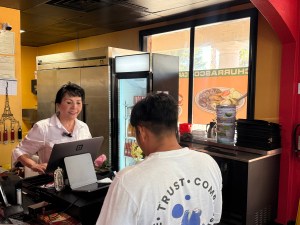
Organizers behind free financial education classes in Nevada say building confidence for participants is a key reward. (Hispanic Access Foundation)
|
By Public News Service
Las Vegas-area families are invited to join free monthly workshops through a pilot program aimed at helping residents—especially bilingual families—strengthen their money management skills.
The outreach is led by the Hispanic Access Foundation’s Latino Financial Empowerment Initiative. Classes will be taught by financial planners at local churches and community centers, with instruction in English and Spanish.
“The topics are budgeting 101: looking at your income versus your expenses, how to begin saving, how to get out of debt, and then planning for the future,” said Magali Robinson, senior director of economic mobility with the Hispanic Access Foundation.
The initiative aims to reach 150 people per month through the end of the year. The classes will also address bank account options, life insurance, health insurance and legal documents that can help protect finances.
|
|
|
Join COURIER and 3.14 Action on June 11 for Facts vs. Fiction: The Fight for Science in American Democracy.
Misinformation isn’t just noise. It’s shaping policy decisions that determine who can afford care, which communities are protected, and how our government responds to real-world risks.
This live conversation will examine what’s at stake when facts are ignored and how science-informed leadership has shaped policy on healthcare, climate, agriculture, and public health. At a moment when institutions and public trust are under attack, we’ll explore what happens when decision-making is driven by evidence, what it takes to rebuild trust, and why scientific integrity is essential to democracy.
Stay tuned for more speaker announcements, and don’t miss this conversation.
|
|
|
🟣 Terrible’s enters agreement with Primm family to keep stateline businesses open. KTNV
“[Terrible’s said] ‘Our immediate priority is ensuring continuity for the current employees, residents, guests, and business partners while establishing a solid foundation for future growth’ … This comes less than a month before the impending last day of business originally set for July 4, 2026.”
🟣 GM investors concerned about lithium mine operation in Northern Nevada. KNPR
“‘As women of faith, we feel that it is important to stand with people that have already been harmed, to call out current harms that may be happening to them, and just speak out for future generations,’ said Sister Susan Francois of the Sisters of St. Joseph of Peace, which put forth the measure and owns shares in GM. The earnings from those stocks fund the Sisters’ mission to support those in need.“
🟣 Can a burned desert watershed bounce back? Nevada restoration efforts offer clues. KUNR
“The effort is only the first step in a longer restoration process that includes invasive plant removal and water management improvements designed to slow runoff and increase soil absorption … The goal is to improve wildlife habitat while strengthening a watershed that eventually feeds the Colorado River, a key water source for much of the Mountain West.”
|
|
|
Have you shared this newsletter with a friend?
|
|
|
Thanks for reading. This newsletter was written by Jannelle Calderón with a story from Public News Service. It was edited by Paula Solis.
The Nevadan is free for everyone. Your support makes our work possible.
|
|
|
You are receiving this email because you opted in via our website.
Our mailing address is:
The Nevadan / COURIER Newsroom
3229 Greenpoint Ave., PMB 532
Long Island City, New York 11101
Want to change how you receive these emails?
You can update your preferences or from this list.
|
|
|
|