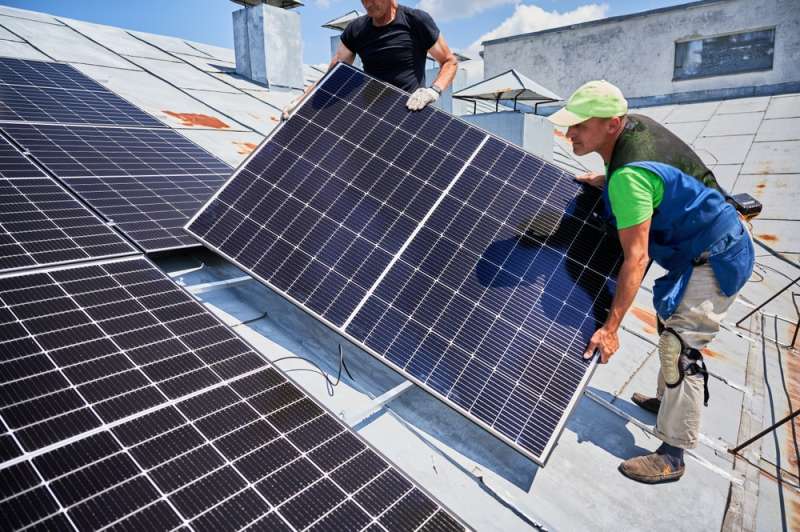
Nevada homeowners who want rooftop solar power installations may be able to reduce the cost of a new system through a prepaid lease program, Nevada BRIGHT, offered by the Nevada Clean Energy Fund (NCEF).
Nevada BRIGHT is run by the fund in partnership with the Nevada Climate Association (NCA) and solar installer Sol-Up. The program is intended to help homeowners after Republicans’ “One Big Beautiful Bill” Act (H.R. 1) ended the 30% federal Residential Clean Energy Credit for expenditures made after Dec. 31, 2025. It uses a prepaid lease model intended to pass along savings associated with commercial solar tax credits to homeowners.
“We are proud to partner with NCEF to bring more affordable solar solutions to homeowners across Nevada,” said Steve Hamile, CEO of NCA, in a statement. “This program demonstrates how innovative partnerships can unlock clean energy access for more communities.”
The fund said participants can save 15% to 25% on a system’s total installation cost. But the discount does not eliminate the cost of going solar: homeowners still must pay or finance the remaining balance using the Residential Energy Upgrade Program (RE-UP) loan program. Their savings will not be immediate.
“It’s not instant savings,” said Will Pregman, senior program manager for Nevada BRIGHT at the NCEF. “Solar is long-term and a longer-term investment.”
Pregman estimated that a solar power system without battery storage could cost about $30,000, though prices vary by home and system size. A 25% reduction would bring the price of that example system to about $22,500, leaving the homeowner to pay or finance the balance.
For homeowners who finance a system, the monthly loan payment can initially replace much of what they had been paying in electric bills, Pregman said.
“If your monthly energy bill, for instance, is $200 or $300 a month in the summer, and you take out a loan to pay your portion of the solar system cost, and that monthly payment is somewhere around $150 to $200, you’ve essentially traded one cost for the other,” Pregman said.
The larger financial benefit may come after a system is paid off. Pregman said solar systems typically reach a break-even point in about eight to 12 years, depending on financing terms, interest rates, household energy use, and the amount of electricity the panels produce.
Nevada BRIGHT’s six-year lease period is separate from any financing timeline. Under the program, the NCA owns and maintains the solar system for at least six years. Homeowners may have the option to take ownership after that period, according to the NCEF.
The program does not have an income requirement, but eligibility does not mean solar will work financially or practically for every household.
Participants still need to cover the remaining cost of a system, which may require cash or financing. Some homes may need roof repairs, roof replacements, or electrical panel upgrades before panels can be installed. Homeowners association rules can also shape where panels are placed and affect a system’s design.
“There is still some portion of the cost that is going to have to be paid by the household,” Pregman said. “And how they finance that is a consideration and then also just their particular house and how suitable it is for solar.”
The NCEF began collecting nonbinding letters of intent from interested homeowners in December 2025, Pregman said. About 50 households signed the early forms, and the fund bulk purchased equipment for about 330 kilowatts of solar capacity based on their estimated needs.
The organization said the initial equipment is nearly fully installed or allocated. More than a dozen of the initial letter of intent signers indicated they wanted to move forward, and the fund later received about 40 additional interest form submissions.
The fund is also expanding the program through community partnerships, including Clark County’s Switch Together group-buy program. According to the organization, Clark County residents who enroll in Switch Together can access Nevada BRIGHT’s discounted solar offering with financing from the NCEF.
Nevada BRIGHT is expected to continue after the initial batch of equipment is used because its savings model is tied to the prepaid lease structure, not only to the bulk purchase, Pregman said.
Homeowners interested in Nevada BRIGHT can complete an interest form online and submit a utility bill. Sol-Up uses the information to estimate a household’s electricity use and create a system proposal. The utility must approve the system before it can be connected to the grid.