Once Boulder City residents heard of the nearly 86-acre data center proposed to be built on public land—less than three miles away from residential homes—whispers began that the historic city could soon become a ghost town.
“It’s a lot of people’s personal opinion that we will become a ghost town not too far down the road,” Boulder City resident Branden Smith said in an interview with The Nevadan. “It’ll just be uninhabitable here. Our water issue continues to deteriorate… our tourism is down. There’s a magnitude of issues at play here.”
Smith added that some residents can see the proposed location from their backyards.
Though the data center on the Bureau of Land Management land has stalled, many residents fear the fight isn’t over.
Boulder City, along with advocacy groups, appealed the BLM’s decision and an administrative judge from the Department of Interior ordered an official stay on the project. The judge ordered the developer to complete a comprehensive environmental study to ensure the land is viable for the artificial intelligence data center.
In late August, however, Lombardo signed a memorandum of understanding with the Trump administration with the intent to expedite data center development on public land in Nevada.
“This agreement will help Nevada cut through unnecessary delays, improve coordination with our federal partners, and move critical projects forward,” Lombardo said in a statement. “By making the permitting process more efficient and predictable, we can support responsible growth, strengthen our economy, and deliver results for Nevadans.
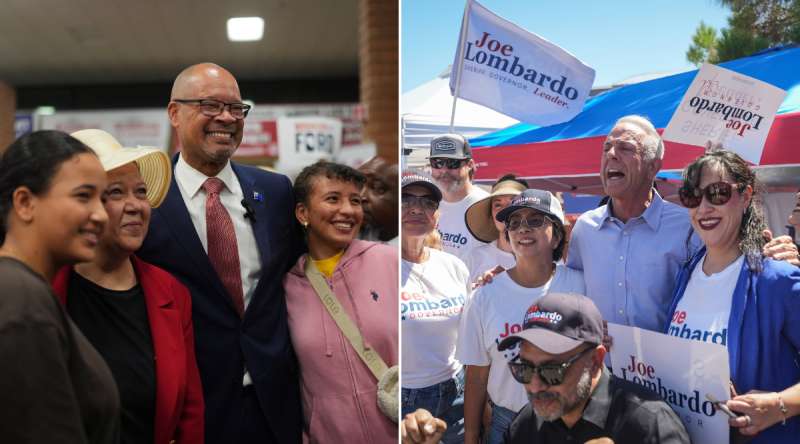
At Democratic Attorney General Aaron Ford’s town hall on Oct. 4, residents told The Nevadan they are staunchly against the giant tech warehouses trying to invade their town—and that this issue could potentially help swing the Nevada governor’s race.
“The outreach for this protest has been quite significant,” Smith said. “We talked to a lot of people and have support from a whole lot of people who wouldn’t otherwise see eye to eye on most other stuff.”
While data center development is largely supported by the right, Boulder City leans Republican.
Where do Lombardo and Ford stand on data center growth?
Republican Gov. Joe Lombardo supports data center development and recently signed an executive order to provide what critics say are loose guardrails on the tech development in the state. The tax breaks would continue if developers fulfill statutory requirements that have yet to be established.
Ford, on the other hand, pledged to pause data center tax breaks if elected governor this November. Nevada has provided almost $461 million in tax abatements to data center projects.
In Ford’s plan, he said Lombardo has “failed” at holding developers accountable. Lombardo’s Governor’s Office of Economic Development has not tracked whether the tech warehouses are benefiting Nevada communities in exchange for the abatements.
Ford co-sponsored 2015 legislation to grant tax abatements to data centers. At the Oct. 4 town hall, a Boulder City resident asked why Ford no longer supports the tax breaks.
The attorney general, who will compete against Lombardo this November, told the resident “the data center of 2015 is not the data center of 2026,” citing increased water and energy used due to the development of artificial intelligence.
“What’s responsible for elected leaders is to not get tied to dogma, when the dynamics have changed,” Ford said at the town hall. “… What I’m responding to, are those changes in dynamics and being responsive to what you are telling me your concerns are. It seems to me that’s what you would want in an elected official.”
Could local frustration sway undecided voters?
The biggest difference between Lombardo’s and Ford’s proposed data center plans is pausing the tax abatements. Smith feels this could be a big enough difference to sway undecided voters, but not the staunch Republicans, even if they are against data centers.
Boulder City resident Kendra Dyson told The Nevadan that because residents are tired of data centers and concerned about their water and environmental resources, it could “push someone one way or another” to vote for a specific candidate.
“By and large, everybody’s been against them,” Dyson said in an interview. “… We really like the small town feel of Boulder City, that’s why people come here and we don’t want to lose that. Especially if data centers bring noise pollution or extra heat or drain our resources. That’s not something that we want for our town.”
At the end of the town hall, one undecided voter—who actually supports data center development—told The Nevadan they will vote for Ford because of his “responsible legislation” regarding the tech warehouses.
“I’m an independent, I’m voting for him,” said the retired union worker, who wished to remain anonymous. “I came to listen … he’s taking the lead on [legislation]. I don’t hear anything from the other campaign.”
Ford already sent in bill draft requests for the next legislative session to expand the Public Utilities Commission of Nevada with commissioners who have consumer protection experience and to require data center developers to pay for their own power infrastructure.
While Smith supports Ford’s plan, he wishes Ford would’ve answered his question about supporting a moratorium until major guardrails are set into place for data center development at the Oct. 4 town hall.
“I would’ve liked to have had that question asked and answered,” Smith told The Nevadan. “… I think it would be great for his campaign.”
Smith added that with such negative sentiment regarding data centers, he feels it would be an easy victory if Ford voiced support for a moratorium.
Early voting in Nevada begins Oct. 17 and ends Oct. 30. Nevada has same-day registration, meaning voters can register right before they cast their ballots.