We’ve seen the future of Nevada, and it looks dry.
That’s probably no surprise considering the Silver State is one of the driest states in the country.
We are also currently experiencing abnormally high to exceptional drought conditions throughout the entire state. Nearly 90% of Nevada is in an active drought, according to this week’s US drought monitor map.
Nevada droughts directly affect people and the environment in numerous ways, physically, mentally, and economically. On a broader level, drought leads to increased wildfires, reduced agricultural production, and declines in tourism.
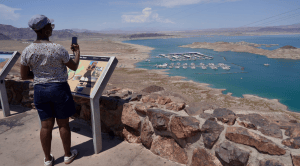
And this isn’t just Nevada’s problem. Lake Mead and Hoover Dam supply drinking water, irrigation, and hydroelectric power for about 40 million people across America’s Southwest.
The Colorado River Basin, which feeds Lake Mead and Lake Powell, is experiencing a tier-one shortage. While it’s fun to learn about sunken treasures under Lake Mead, their reemergence (and the enormous bathtub ring around the edge) are real-time signs that the manmade Southern Nevada reservoir is at a record low.
Though we aren’t currently experiencing water-shortage declarations at home, droughts in Nevada are projected to worsen, leading to a drier future.
What is a drought?
NASA defines a drought as “a period of unusually persistent dry weather that continues long enough to cause serious problems such as crop damage and/or water supply shortages.”
Simply put, a drought is when there’s not enough water to meet needs.
According to the College of Agriculture, Biotechnology, and Natural Resources for the University of Nevada, Reno (UNR) Extension, droughts in Nevada can be meteorological, hydrological, agricultural, ecological, or socioeconomic. Causes include climate change, ocean temperatures, changes in the jet stream, and changes in the local landscape.
While climate change has become a political talking point in recent years, NASA states that “there is unequivocal evidence that Earth is warming at an unprecedented rate,” and that human activity is the primary cause.
What’s being done about it?
The Southern Nevada Water Authority (SNWA) has been working with federal, state, and municipal water providers for decades to slow the loss of Lake Mead’s waters, in collaboration with California and Mexico.
SNWA has had some success, reporting a 58% reduction in per capita water use between 2002 and 2025, despite population increases.
To save additional water, in 2027, the Las Vegas Valley Water District (LVVWD) will begin using decorative grass in medians, roundabouts, business centers, HOA entrances, and along parking lot borders.
The federal government recently proposed a 10-year plan to manage Colorado River water shortages with major cutbacks for Nevada. According to the Nevada Current, there is pushback from the governor and local agencies who believe Nevada, Arizona, California, Colorado, Utah, New Mexico, and Wyoming should share the burden equally.
What can I do about it?
Conserving water during droughts in Nevada is something you can do at home. Sometimes, it’s as easy as fixing a small leak or investing in an energy-saving appliance. A combination of water-saving technology and small steps will help conserve water, reduce water bills, and promote sustainability.
Indoor water tips for Nevada droughts
Just one drip of water per second can waste more than 3,000 gallons a year, according to the Nevada Division of Water Resources (NDWR). The following tips for saving water inside come from the NDWR, the United States Environmental Protection Agency (EPA), Truckee Meadows Water Authority (TMWA), and the SNWA:
Fixing leaks
- If you think there might be a leak in your home, check your water meter before and after a 2-hour period without water use. If the meter reading goes up, there’s most likely a leak.
- You can specifically check for toilet leaks by adding a few drops of food coloring to the tank. If color shows up in the bowl within the next 10 minutes, there’s a leak.
- Consider installing leak-detection and flow-monitoring devices.
In the bathroom
- You may have been told to turn off the water while brushing your teeth, but did you know that doing so can save up to 200 gallons of water per month? The same goes for shaving and other sink-related activities.
- Shave just one minute off your shower to save over 500 gallons of water per year. If you collect water in a bucket while it’s running before you get in, you can use it to water your garden.
- Flushing facial tissue or other trash down the toilet wastes up to 7 gallons of water, especially if it’s an older toilet. Inserting a displacement device into the tank can save up to a gallon or more per flush.
In the kitchen
- Scrape plates instead of rinsing, and wait until the dishwasher is full before you run it. Just one less load a week saves over 300 gallons annually.
- Instead of thawing frozen food under running tap water, thaw it in the refrigerator overnight.
When buying new fixtures or appliances
- Opt for fixtures with the WaterSense label and Energy Star-certified appliances. The added cost will save you money on water and energy in the long run.
Tips for saving water outdoors during droughts in Nevada
About 30% (9 billion gallons) of water used by US households daily is devoted to outdoor use, per the EPA, and that number can spike up to 70% in the summer.
These outdoor water conservation tips come from the NDWR, EPA, SNWA, and TMWA:
Sprinklers and irrigation
- Drip irrigation for shrubs and trees uses up to 50% less water than conventional sprinklers, plus less water is lost to wind, runoff, and evaporation.
- If you do use sprinklers, look for ones that produce droplets rather than mist. The water should hit only your lawn and shouldn’t run off.
Using the water hose
- Use a broom or blower rather than a hose to clean driveways, sidewalks, and steps.
- Likewise, using a pail of water for washing your car or a hose with an on/off control can save over 150 gallons of water. Water can flow from a hose at a rate of over 10 gallons per minute.
Reduce evaporation and water loss
- Applying mulch around trees and plants helps to reduce evaporation. Watering during cooler hours also reduces evaporation, while three short cycles an hour apart allow for better absorption.
- If you want to reduce how much water you lose, avoid watering on windy days. Watering on rainy days is unnecessary and wasteful.
- Taller grass holds moisture better because of its deeper roots, so don’t mow it too short.
- Cover your pool when it’s not in use to reduce evaporation.
Always follow mandatory restrictions
Southern Nevada
Due to water shortages in Nevada, SNWA mandates seasonal water restrictions, such as assigned watering days. These restrictions aim to reduce outdoor water consumption, which makes up 60% of Southern Nevada’s overall water use.
The agency is currently upgrading older mechanical meters with advanced ultrasonic technology to improve accuracy, enhance leak detection, and support long-term water conservation.
Additionally, SNWA has a Water Smart Landscapes (WSL) rebate program that rewards homeowners for replacing nonfunctional turf with drip-irrigated trees and plants. You can currently earn $7 per square foot of grass with this program.
Check the SNWA website for resources, including links to plumbers and videos on fixing leaks. The water authority will provide a $250 voucher if you use one of the water authority’s approved Water Smart Plumbers for leak detection.
If you encounter water waste, you can report it to the LVVWD. The website also provides information on conservation restrictions and water ordinances in Las Vegas.
Northern Nevada
The TMWA has a three-day-a-week assigned-day watering schedule for sprinklers, though drip systems and hand watering are ok any day. According to the agency, outdoor watering by residential customers increases consumption by up to 10 times during summer.
Watering is prohibited during the heat of the day from Memorial Day through Labor Day. Northern Nevada uses four times as much water for landscapes during the warm months as during the winter months.
Where can I enjoy water-friendly landscapes and learn more about water use in Nevada?
Las Vegas Springs Preserve
The 180-acre Las Vegas Springs Preserve, 333 S. Valley View Blvd., knows a thing or two about water and conservation. This environmentally conscious attraction with water-friendly botanical gardens, museums, family events, traveling exhibits, trails, and more is where Mexican scout Rafael Rivera found a spring in the desert in 1829, leading to the formation of Las Vegas.
The Springs Preserve recently opened a new interactive exhibit, WaterWorks Museum, which explores the world of water in Las Vegas. If you ever wondered how water gets to your tap at home, this exhibit is for you.
Galleries including quagga mussel replicas and rock samples excavated from Lake Mead provide an in-depth look at water resource management in the region. You can also look at harmful water contaminants under a microscope and learn how local nonprofits are working to protect the world’s water supplies.
Tickets to the Springs Preserve for Nevada residents are less than $10.
UNR Botanic Garden
See an expansive, water-smart collection of plants at the University of Nevada, Reno Cooperative Extension’s free outdoor Botanic Garden, 8050 Paradise Rd., Las Vegas. The seven-acre garden features 4,500 different plant types. There’s also a habitat for the declining monarch butterfly population, a pine grove, herb and vegetable gardens, and a mini-orchard with fruit trees.
Baepler Xeric Garden
The two-acre Donald H. Baepler Xeric Garden at 4505 S. Maryland Parkway in Las Vegas was built long before xeriscaping became popular in Southern Nevada. Located on the UNLV campus near the entrance to the Marjorie Barrick Museum, the public garden is a living laboratory of desert plants, both native and non-native plants from the four desert regions of North America, Australia, South America, Mexico, and the Mediterranean.
Valley Wood Park Wildlife Gardens
Valley Wood Park Waterwise Gardens, 6555 Valley Wood Dr., Reno, features drought- and pollinator-friendly native plants that thrive in the semi-desert climate. The plants attract butterflies, hummingbirds, and other pollinators.
You can also check out other public gardens in Reno.
This article first appeared on Good Info News Wire and is republished here under a Creative Commons license.
Related: Celebrate the changing season at these 11 Nevada fall festivals