By Phillip I. Earl, RGJ archives
A version of this article first appeared in the Reno Gazette Journal in 1984.
Nearly seven decades after statehood, Nevada still had no official state song.
Several compositions had been offered over the years for official status, but it was a piece by Bertha Eaton Raffetto of Reno that was ultimately chosen.
In the early summer of 1932, Raffetto was asked to sing a Nevada song at the annual picnic of the Nevada Native Daughters scheduled to be held at Bowers’ Mansion on July 31. She assembled her notes, but family matters and the arrival of guests from out of town forced her to lay the work aside until the day before the promised performance.
Working from 10 a.m. July 30 to 4 a.m. the next morning, she wrote the song and set it to music. She then got a few hours sleep before driving out to Bowers. That afternoon, she played and sang “Home Means Nevada” from a lead-pencil script.
RELATED: I finally celebrated Nevada Day after living here my whole life—here’s what I found
The song was so well-received that former Gov. Roswell Colcord came to congratulate her afterwards and suggest that the song be made the state anthem. Lt. Gov. Morley Griswold, also in attendance, concurred with Colcord, as did others present that day.
Raffetto had already achieved some renown in local musical and literary circles, with one published Nevada song, “Silver Rain,” and seven love songs set to a foxtrot beat. A waltz, “Kingdom of Make-Believe,” had also been copyrighted, as had a classic, “Serenity,” performed on the London stage by Madame Schuman, a German opera singer.
Raffetto was also the poetry editor for the Nevada State Journal and was associated with the Reno branch of the National League of American Pen Women, an organization of women writers.
Southern Nevada lawmakers irked by lyrics
Over the next seven months, Raffetto performed “Home Means Navada” nearly 200 times for social, literary, patriotic and women’s groups. On Oct. 31, 1932, Nevada Day, she sang at Reno events and was heard by several thousand people. The University Glee Club and the Reno Municipal Band backed her up that day and Professor Theo H. Post of UNR’s music department sang another of her compositions, “Nevada, Paint Me a Picture.”
By the time the Legislature met in January 1933, Raffetto had a number of endorsements for making her song the state’s official anthem. Among those Nevadans who came forward were officials of Reno’s local American Federation of Musicians, several American Legion Posts, the Royal Neighbors of America, Reno’s Central Trades and Labor Council, the Knights of Pythias, Rebekah Lodges, the Nevada State Horticultural Society, the Relief Society of the Latter-day Saints Church and the Mormons’ Mutual Improvement Association.
On Jan. 26, Raffetto sang before a joint session of the Legislature. An Assembly Joint Resolution to adopt “Home Means Nevada” as the state song was reported out of committee that day, but some Southern Nevada legislators objected to the measure unless there was some mention of a river in their section—either the Colorado or the Amargosa.
They finally voted for the resolution, however, and it passed without a single dissent. The resolution was sent on to the Senate, but a legislative legal expert told leaders of the upper house that a resolution was not a law and that a favorable vote on the Assembly measure would not be sufficient to make the song official.
The next day, Jan. 27, Senate Bill 7 was introduced and sent to the Library and Public Morals Committee. The measure came back with a favorable recommendation and was passed, 12-5, on Jan. 30.
Those voting against the bill included William F. Dressler of Douglas County, T.R. Fairchild of Elko, Ira L. Winters of Ormsby County (now Carson City), W.W. Carpenter of Pershing and A.L. Scott of Lincoln County. Several of those who cast affirmative votes indicated to the press that they cared for neither the song nor Raffetto’s presentation, but voted in favor of the bill because they did not want to offend her.
Waiting for something more ‘catchy’
Sen. Scott was more forthright, however, telling a newsman that he voted against the bill in hopes that a “more suitable and catchy piece of music” would be written and submitted to the lawmakers in the future.
When the measure came up in the Assembly, the first vote was 28-3 in favor, with one Assemblyman not voting and six absent. Those voting in the negative were L.F. Anderson and Morley Murphy of Elko County and Walter Lage of White Pine.
When the clerk announced that the bill had passed, Assemblyman Douglas Tandy urged the three to change their votes as a “gracious gesture” and they complied. Gov. Fred Balzar signed the bill into law Feb. 6.
Most Nevadans know a little of the chorus, but those who can sing both verses are as few and far between as Americans who know all four verses of “The Star-Spangled Banner.”
Way out in the land of the setting sun
Where the wind blows wild and free
There’s a lovely spot, just the only one
That means home sweet home to me
If you follow the old Kit Carson Trail
Until desert meets the hills
Oh you certainly
will agree with me
it’s the place of a thousand thrills
Home means Nevada, home means the hills
Home means the sage and the pine
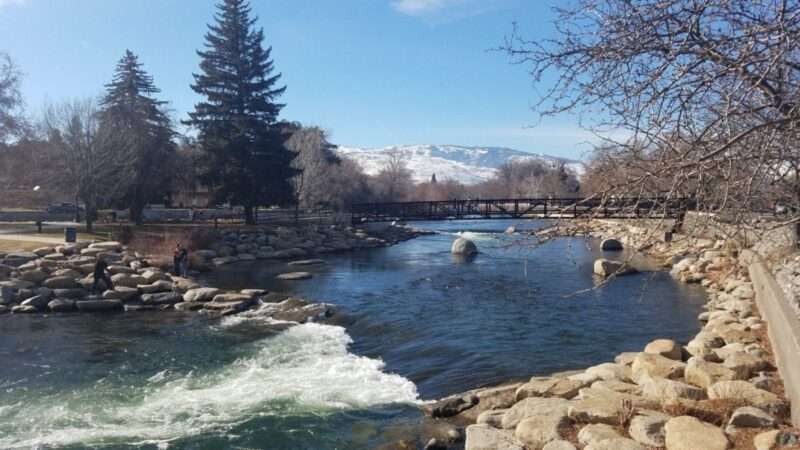
Out by the Truckee’s silvery rills
Out where the sun always shines
There is the land that I love the best
Fairer than all I can see
Right in the heart of the golden west
Home mean Nevada to me
Whenever the sun at the close of day
Colors all the western sky
Oh my heart returns to the desert gray
And the mountains tow’ring high
Where the moonbeams play in shadowed glen
With the spotted fawn and doe
All the live-long night until morning light
Is the loveliest place I know
Home means Nevada, home means the hills
Home means the sage and the pine
Out by the Truckee’s silvery rills
Out where the sun always shines
There is the land that I love the best
Fairer than all I can see
Right in the heart of the golden west
Home mean Nevada to me.
ALSO READ: The stories behind 4 ghost towns in Nevada that are worth exploring
Phillip I. Earl was curator of the Nevada Historical Society.
USA TODAY Network via Reuters Connect