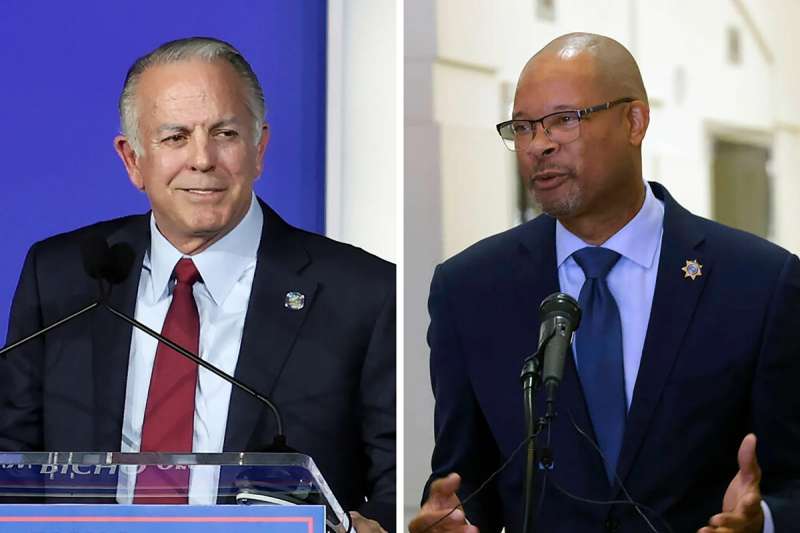
NV Energy’s new daily demand charge is set to take effect in southern Nevada on Jan. 1, about two months after Nevadans choose their next governor. Incumbent Gov. Joe Lombardo, a Republican, and his Democratic challenger Attorney General Aaron Ford, have staked out opposite positions on it.
Lombardo, whose appointees to the Public Utilities Commission of Nevada (PUC) approved the charge, says the decision belongs to independent regulators. Those same independent regulators are appointed by the governor. Meanwhile, Ford sued to block the charge and said as governor, he would stop it
The Nevadan sent both campaigns questions on the demand charge, utility regulation, data centers, and utility campaign contributions. The Ford campaign responded. Lombardo’s positions are taken from public record and statements.
What the demand charge is
The demand charge is a daily fee based on a customer’s highest 15 minutes of power used each day. It was approved as part of NV Energy’s general rate case.
According to the utility company, the fee is being charged to cover a growing rooftop solar movement that still needs the grid, but doesn’t always use it. NV Energy says customers without rooftop solar must shoulder those costs. Solar advocates disagree, saying the utility’s math overlooks the value that rooftop solar adds to Nevada’s environment and burdened grid system—and that NV Energy is shifting blame to rooftop solar customers who are trying to reduce their bills and their impact on the state’s natural resources any way they can.
According to NV Energy, most customers will see little to no change in their bills due to the demand charge, unless they change their energy use habits. Critics claim some NV Energy households will indeed notice the charge on their utility bills by as much as $20 a month, and that a governor invested in both grid reliability and the future of the state’s environment should work to end NV Energy’s fee being passed down to customers.
‘The governor does not interfere’
Lombardo said the charge was the regulators’ call. A fact check by The Nevadan found that it is true that the regulators make the decisions, but the governor appoints the regulators.
In June, his campaign told News 3 that the governor does not interfere with the PUC’s decisions. Lombardo’s campaign went on to defend NV Energy’s demand charge, claiming the intention of the charge is to reduce customers’ bills.
Advocacy groups like Vote Solar have asked Lombardo to freeze energy rates, citing states like New Jersey, where governors have used their executive power to make energy more affordable.
Ford: Fighting the charge in court
Ford pledged to “put a stop” to mandatory demand charges on residential customers in Nevada if elected, and accused Lombardo of sitting on the sidelines and making life more expensive for Nevadans.
So far, the courts have sided with energy regulators. A Clark County judge denied a Bureau of Consumer Protection’s petition on May 26, and opponents lost a second case days later. Ford appealed, and the case is pending at the Nevada Supreme Court.
The bureau argued the charge is an unlawful time-of-use rate and the PUC lacked authority to approve it.
Ford said the “demand charge price hike [is] set to increase Nevadans’ bills by hundreds of dollars a year. Meanwhile, I am fighting to stop those companies from implementing Lombardo’s demand charge.”
Who picks the regulators
The governor’s clearest power over utility rates is choosing the people who set them. All PUC commissioners are appointed by the governor.
Two of the current commissioners were first chosen by Lombardo’s predecessor, Steve Sisolak. Chairs Hayley Williamson and Tammy Cordova were reappointed by Lombardo in 2023. Commissioner Randy Brown was appointed by Lombardo in 2023 as well.
The commission’s structure could change in the near future. Bill draft requests filed ahead of the 2027 legislative session included a proposal to expand the PUC to add three members focused on consumer protection.
READ MORE: Nevada’s Lombardo limits data center tax breaks following voter pushback
Data centers and future bills
The fight over NV Energy’s new demand charge is part of a bigger question for Nevada families: As power-hungry data centers move in, who will pay for the electricity and grid upgrades they need? Both candidates say those costs should not show up on residential bills, but they disagree over whether the industry should keep receiving tax breaks.
Data centers already account for about 22% of Nevada’s electricity consumption, and NV Energy estimated 12 planned projects will demand 5,900 megawatts.
Lombardo signed an executive order in mid-September requiring data centers seeking tax abatements to pay the Local School Support Tax and sign a binding community commitment. His office said it will ensure no costs are passed on to ratepayers.
The industry’s Data Center Coalition said some of the policies in the executive order create additional hurdles to data center development.
Ford said he would halt data center tax abatements entirely, and require developers to bring their own water and pay for their own electricity.
Ford’s campaign dismissed Lombardo’s executive order as keeping industry giveaways in place.
Utility campaign money
Nevada’s major utilities have given to Lombardo but not to Ford, according to the Energy and Policy Institute.
EPI reported in April that no other candidate for governor received money from utility companies, while Lombardo received $40,000 from NV Energy and Southwest Gas.
What voters need to know
Voters may never hear the candidates debate these questions. As of the time of publication, no debate dates or venues have been agreed on by both candidates, while mail ballots began going out on Oct. 5.
Ford said he accepted two debates, one on Oct. 8 and another on Oct. 13. Lombardo’s campaign told the Las Vegas Review-Journal that he would not be attending those debates. He said his campaign had accepted a separate invite, but did not provide any timeline on when that could happen.
Early voting runs from Oct. 17 -30.
Check your polling location, register to vote, or see what’s on your ballot here. The election is on Tuesday, Nov. 3.