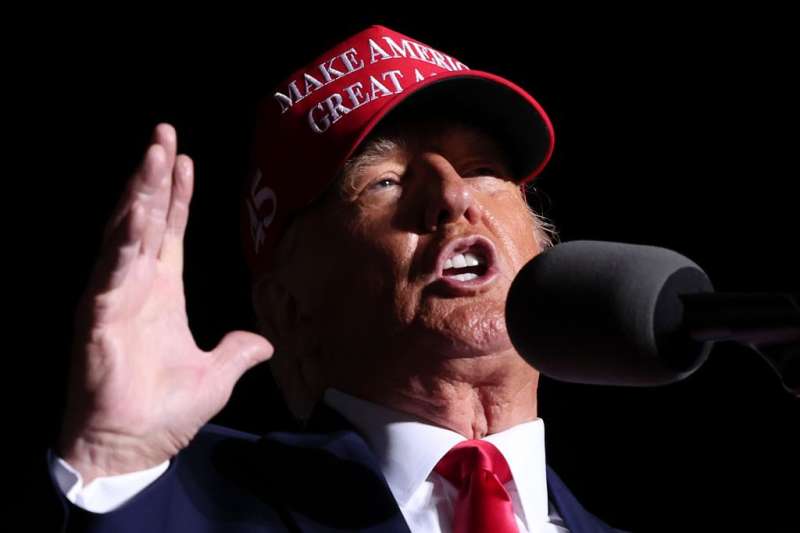
More than nine years after he launched his first campaign for president, much of the media continues to struggle with how to cover Donald Trump. In a new op-ed, Jordan Zakarin describes the failures to hold Trump to account.
It should matter that Donald Trump last Saturday wandered away from his normal stump speech and into a long and uncomfortable tangent about golf and the evidently impressive nature of Arnold Palmer’s driver.
There’s no charitable read on a major candidate for president waxing poetic about a dead golfer’s genitalia: whether it was a sign of dementia or being demented, of forgetting where he was or just not caring, if Trump were anybody else, it would have been front page news and the dominant topic on cable for days on end. But because it was Donald Trump that said it, the New York Times just called the digression “golf jokes” and moved on, changing the description only under pressure from Twitter critics.
The edit was ultimately a Pyrrhic victory, analogous to using a medicine dropper to take out a single drop of water from a bottomless bucket that’s been filled to the top for years. The comments adhered to the normal Trump cycle: initial reactions of social media, then a few memes, and maybe a follow-up story before being replaced by the next one.
And it wouldn’t be a big deal if Trump’s fascination Arnold Palmer’s genitalia shrunk from the news cycle if the same exact thing was not about to happen with a new story detailing Trump’s admiration for Hitler, disrespect of dead WWII soldiers, and ripping off the mourning family of a Hispanic soldier who was killed at Fort Hood while he was president.
Legacy media’s habit of tidying up and repackaging Donald Trump’s inexplicable tangents into coherent summaries and ignoring his most vicious hate speech is now just the new normal of a broken information ecosystem that warps further every single day.
The examples from the past few weeks alone are too plentiful and painful to fully recount. Earlier this month, Trump, interrupted by two supporters passing out as he spoke during a rally in Pennsylvania, decided that instead of shutting down the event, the best course of action would be to spend nearly 40 minutes swaying and bopping to an eclectic playlist of old favorites.
If Joe Biden had done it, there would have been calls for his resignation. But for Trump, The Washington Post’s headline, calling the incident “bizarre,” was as far as any big paper or news service was willing to go. The Associated Press called it an “impromptu concert,” while the New York Times said Trumped “bobbed his head” during an “odd town hall detour.”
Two days later, after he restated his lies about the Haitian immigrants in Springfield, OH and said that Jan. 6th insurrections had done nothing wrong during a tough town hall on Univision, the Times simply said he’d “defended or dodged” the questions. Politico wrote that Trump “stays in form,” recapping his statements as harsh, but never unusual. Hate speech, repeated often enough and as part of an ostensible campaign strategy, is now as easy to gloss over as neurons failing to fire in a collapsed star of a brain.
Maybe things are moving too fast to contextualize for a media built on play-by-play. Trump’s lying and babbling are now delivered in bulk, at a record pace. His stump speech has devolved from a series of inane boasts and digressions into a meandering list of false memories, non-sequitur monologues, and bigoted slurs. Perhaps making an assessment of his verbal shockers is impossible when out of nowhere, Trump will do something like yell “they’re eating the dogs!” during a debate or preemptively blame the Jews for his failure.
Any list of this stuff quickly becomes almost as incoherent as Trump without a teleprompter, reading like a chronicle of Deep Thoughts with a racist Jack Handey. As NY Times reporter Maggie Haberman put it last month, “The systems … were not built to deal with somebody who says things that are not true as often as he does or speaks as incoherently as he often does.”
Haberman is right, because the legacy media does run the occasional story on his well-being. It even seemed as if media coverage had turned a corner when the New York Times finally published a story exploring Trump’s obvious cognitive and verbal decline. There was little follow up, but the story, by veteran White House correspondent Peter Baker, did deliver a moment of clarity and key insight into the way the mainstream media works covers politics.
Describing Trump as seeming “confused and disconnected from reality” at a recent rally, Baker noted that the former president frequently appears to be incoherent during public appearances. There were rants that I had totally forgotten about, like the lecture he gave to a fly in the middle of a rally, reminiscences about Michael Jackson and Cary Grant, and whiffing on the names of states.
“It happens so often these days,” Baker asserted, “that it no longer even generates much attention.”
Left unsaid was the fact that as the lead correspondent at the most influential and consequential newspaper in the world, Baker has a whole lot of influence over the amount of attention that is generated by Donald Trump’s mentally incompetent babbling and fundamental indecency.
To be fair, Baker also wrote about Trump’s steepening cognitive decline a month earlier, his entry a late addition to the initial conversation around “sanewashing.” In that piece, Baker teased out several examples of the former president’s incoherence, including his faulty memory and the debates he holds with himself over whether it’d be better to be attacked by a shark or electrocuted in the water.
The details were key, it was implied, because “most voters have not been exposed to Mr. Trump’s stream-of-consciousness style at much length lately.”
One wonders what happened in the month between those stories being published. Did the broad public suddenly become so inundated with transcripts and full-length videos of Trump’s mid-speech dips into dementia that they became old hat? Or did Baker project his own exhaustion with Trump’s asinine rants onto a far less informed public?
I’d bet on the latter, because I know from experience that after living and breathing a beat as a reporter, it’s very easy to get bored and want to move on to something fresh and exciting. It’s natural to underestimate newsworthiness when something isn’t new to you, but the compounding evidence of a morally bankrupt presidential candidate’s obvious mental decay should never be considered an afterthought.
Regardless of motivations, conscious or unconscious, the reality is that only Trump’s most dedicated followers are deeply aware of the frequency of his tangents about sharks and his beach body, manifold misstatements and mistakes, hallucinated conversations, and outbursts of anger. At the same time, the media’s obsessive attention to President Joe Biden’s cognitive acuity, its fixation on every misstatement and gaffe, fueled public concern that he was never able to shake.
It was a good thing that Biden dropped out of the race, both for the country and the power of the media. Now, it’s hard to understand why Trump’s dysfunctional brain hasn’t received anything approaching the same level of scrutiny.
Even more dangerous than the downplaying of Trump’s mental lapses is the ongoing failure to adequately direct attention to the pernicious slurs, lies, attacks, and high crimes that he has committed while at least semi-lucid.
On October 3rd, a judge unsealed a 165-page filing detailing the government’s case against Trump for his efforts to overturn the 2020 election. Special prosecutor Jack Smith assembled a dark narrative of an angry president, well aware that he’d lost a hard-fought election, breaking the law and unbothered his supporters’ attempts to assassinate Vice President Mike Pence. It was explosive stuff — new details about the former president and current GOP nominee’s efforts to engineer a violent coup — yet the bombshell largely fizzled.
According to the press watchdog Media Matters, the nation’s five largest newspapers published a combined 26 stories about the new evidence in the week that followed the unsealing. For context, those same newspapers published 100 articles about Hillary Clinton’s email server in the week following James Comey’s decision to briefly reopen the FBI’s investigation.
Maybe this incongruence shouldn’t come as much of a surprise; the same newspapers expressly refused to publish anything from a trove of hacked Trump campaign emails, deeming them unnewsworthy just two election cycles after spending months running stories based on the Clinton campaign’s hacked emails.
The excuse that they were not newsworthy does not hold water when publishing John Podesta’s favorite recipes were deemed in the public interest eight years ago; my suspicion is that news outlets simply did not want to deal with the inevitable right-wing backlash and lawsuits that Trump would pursue against them — this is a guy who continues to rage and threaten to take away the broadcast licenses of both ABC and CBS over simple fact-checking during debates.
The Washington Post and Los Angeles Times’ decisions to eschew endorsing a presidential candidate goes a long way toward clarifying what’s going on here. The Post’s editorial board had already drafted an endorsement of Kamala Harris, only to have the paper’s owner, Amazon founder and mega-billionaire Jeff Bezos, decide to squash it — and every other presidential endorsement going forward.
His motivations are pretty transparent: In 2019, Amazon accused Trump of screwing the company over on a $10 billion contract out of a personal vendetta against Bezos, and it’s clear that vengeance will be the animating principle of a second Trump White House. Instead of allowing his newspaper’s editorial board to remind the country of the former president’s lawless vindictiveness, Bezos decided to look out for his own interests.
Trump entered politics by claiming that Barack Obama wasn’t born in the United States, maintained his relevance by insisting that he hadn’t actually lost the 2020 election, and is now a coin toss away from retaking the White House with the help of a corporate media that experiences occasional moments of lucidity, but ultimately fails to hold an unprecedentedly dishonest campaign to account.