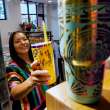
Doris Anahi Muñoz, an artist from Southeast Los Angeles, said she fantasized about one day living in Mexico.
Muñoz added that she realized she had experienced burnout from her work as an activist during her 20s. Now that she’s in her 30s, a friend suggested that she change her perspective on her situation as an American living in Mexico and see how she could still be of service in her new home.
But living in a new country, despite being a descendant of that country, isn’t an easy transition. Muñoz describes residing in Mexico City as a place of healing but adds that it’s a double-edged sword.
The otherness that Latinos face in the US—not being American enough—exists in Mexico as well. Muñoz experienced that firsthand when a Mexican kid noticed her Spanish accent and asked her where she was from. Due to the increase in gentrification, particularly in Mexico City, she felt compelled to share her entire background story with the child to explain why she was in Mexico in the first place. The kid said, “‘Oh, you’re a gringa,’” to which Muñoz responded, “Don’t call me that.” “I’m not a gringa in the US, so please don’t call me that.”
So the notion of neither being American enough nor Mexican enough continues to plague this group of Latinos.