Beth Osborne, a Las Vegas writer and activist, had an abortion as a teenager. Now, she is working to convince Nevadans to approve Question 6 on their November ballots to preserve safe, legal abortion in the state. She shared her story with The Nevadan’s special correspondent Bonnie Fuller.
I had an abortion on my 18th birthday. I was living in the small, conservative town of Miller’s Creek, North Carolina, where I grew up.
I was in my senior year of high school. At 17, I was dating an older guy who was 24, which I thought was cool. But he was very controlling.
It wasn’t that I wasn’t educated. I knew about birth control, but I just wasn’t using my head. I was a pretty smart girl, but not about this. I just didn’t think getting pregnant would happen to me, and my boyfriend wasn’t worried about it either.
Then I noticed that I missed my period, but it wasn’t until I started getting really sick in the mornings that I was like, “This is really concerning.” I told my boyfriend, and we went and bought a pregnancy test.
It was positive.
I only told a couple of my closest friends what had happened, and one of them went with me to see a female OB-GYN in the county next over. She confirmed the pregnancy and then asked me what I wanted to do about it.
My answer was immediate: I wanted an abortion. I was just 17, and I was focused on going to college in the fall and getting an education. I knew I wasn’t capable of bringing a child into the world and raising it.
But the OB-GYN told me that since I was still a minor, I would need to get a parent’s consent in North Carolina to get the abortion.
That was going to be a problem.
I was raised by a single mother. My dad had never really been in the picture, but I was very close to my mom, who was a teacher. Then, when I was 15, my mother was diagnosed with leukemia, so my teenage years from that time on were not normal.
I was effectively the head of our household. My mom was dying in front of my eyes. She was in and out of the hospital. It was really hard.
When I found out I was pregnant, there was no way that I was going to put that on her plate.
I love my mom very much, and I still miss her every day, and it’s been almost 30 years. She died within a year after I found out that I was pregnant.
‘Protesters told me I was going to hell’
I know I could have told my mother about my pregnancy. Despite our town being very conservative and religious, it wasn’t like there was any talk in my household about abortion being terrible. I knew that my mom wouldn’t have loved me any less, and she would have taken me to get the abortion.
But I just could not let her know that I had allowed this pregnancy to happen.
I just couldn’t say the words — that I was pregnant — to her.
I needed her to only think that I was the best daughter and that I was good. I didn’t want to tarnish my image with her.
The only way to bypass the requirement for a girl under 18 to get a parent’s permission for an abortion in North Carolina was to ask a judge to waive it.
So my boyfriend made an appointment for me to speak to a judge, in hopes that I could get the waiver for the abortion. I went and testified in front of the judge about how my mother was dying and how I just didn’t want to burden her with the knowledge of my pregnancy.
But he denied my request. I was sad and worried, but at least my birthday was coming up in a few weeks, so I knew I would still be able to get the procedure before the state’s 20-week cutoff for an abortion.
That’s why I scheduled the abortion at a clinic as soon as I could get it, which was on my 18th birthday, when I was 14 weeks pregnant.
I remember walking into the clinic past protesters who were telling me that I was going to go to hell. Before I had the abortion, the law required that I have an ultrasound and that I look at it. It seemed very unnecessary and cruel.
But then I had the abortion, which was pretty quick. Afterward, I was very relieved, but I was in pain and bleeding for days afterward.
Advocating for Question 6 in Nevada
Having that abortion was the best decision I could have made for me at the time. That’s why I’m working today with Planned Parenthood, Indivisible and other groups in Nevada, where I’ve lived for the past eight years.
My mission is to help get out the vote to pass Question 6 on the Nov. 3 midterm ballot.
Nevada’s Question 6 is the Right to Abortion Initiative, which, if passed, would add an amendment to the Nevada Constitution guaranteeing the right to an abortion in the state.
Since I was 17, women’s rights and access to reproductive care have gone backward in this country, especially after the Supreme Court overturned Roe v. Wade in 2022.
In my home state of North Carolina, women used to be able to get abortions up to 20 weeks of pregnancy, but not anymore.
Editor’s Note: Abortion is legal in North Carolina today only up to 12 weeks and six days.
That’s why it’s so important to protect our right to an abortion in Nevada’s Constitution now. I want people today and in the generations to come to have the same rights that I and my generation had.
After my abortion, the clinic gave me a prescription for the birth control pill, which I stayed on while I was in college. Then I switched to the Depo-Provera shot.
My decision to have an abortion was the right one for me. My mom wanted me to go to Wake Forest University, which I did for a year. Then I transferred to the University of North Carolina at Greensboro, where I finished my bachelor’s degree before getting a master’s degree at the University of North Carolina at Charlotte.
Today, I’m a writer.
‘I’ve never regretted my decision’
If I hadn’t had the abortion, none of my university education would have happened, and I would have been tied to a controlling man who was emotionally and sometimes physically abusive to me.
He wouldn’t let me do things with my friends unless he was there, and he would tell me that no one cared about me except him. Who knows how much worse it would have gotten with a baby involved.
Then he died six years later from a drug overdose.
Meanwhile, my mom and then my grandmother died, so I was on my own in the world by the time I was 19 years old.
I’ve never regretted my decision to end my pregnancy, even though five years after the abortion, I was diagnosed with ovarian cancer at age 23. I had a recurrence of the disease at 27 and then again at 30, when I was forced to have a hysterectomy to protect my health.
It’s very rare to get ovarian cancer at age 23. It was discovered when I went for a regular gynecology checkup. I told my doctor that I was peeing all the time and I didn’t know if that was normal. I also said that I could kind of feel something on my right side. I was very, very thin at the time.
My OB-GYN sent me to see a urologist, who performed an ultrasound. The ultrasound showed that I had a football-sized tumor on my right ovary and appendix.
I was in surgery within a week. I was diagnosed with a stage 2 borderline ovarian tumor, which is a slow-growing disease and is very rare. So rare that I donated the tumor tissue to Duke University so that it could be studied.
My doctor at that point assured me that I would be fine. I still had an ovary, so I could have children if I wanted to. He explained that I didn’t need to undergo chemotherapy because it wasn’t effective against this tumor.
Then, a few years later, when I was 27 and had moved to Charlotte, I saw a new gynecological oncologist. When he performed an ultrasound, there was a new but small tumor on my left ovary.
He was able to remove it and still leave part of that ovary. He was a really good doctor, and he checked me every three months with an ultrasound. Unfortunately, when I was 30, there was a new tumor on that ovary and on the left fallopian tube.
At that point, he told me that I would need to have a hysterectomy and remove all my reproductive organs to keep me healthy. And when he operated on me, he discovered that the tumor cells were also in my lymph nodes, so they had to be removed as well.
That was 18 years ago, and I have been fine ever since.
Societal expectations of motherhood
After my first and second operations and before the third, there was a lot of pressure from medical officials to consider freezing my eggs in case I wanted to have children in the future.
They were constantly asking me: ‘Don’t you want to be a mother?’
I’m sure they just wanted me to know that I had this option, but that’s not what I ever wanted. I didn’t have a desire to have kids or be a traditional wife.
And honestly, just going through all these surgeries, I was only focused on trying to survive and live my life.
I know that there are anti-abortion people who would say that I got what I deserved, but I don’t think there is a demerit system on who should or shouldn’t get cancer.
I’m not a religious person, but I’m a spiritual person, and I care about being a good person on Earth. I did not think about my pregnancy as being more than a mass of cells.
I realized through my experience that you don’t know if the woman beside you at work or in class has had to make the hard decision to have an abortion. It’s not my business, and it’s not my job to cast judgment on anybody’s decisions.
What I do feel strongly about is that elected officials and the government should have nothing to do with legislating abortion. This should be a decision that women make with their healthcare providers, full stop.
Pushing back against abortion shame and stigma
That’s why I’ll be working with Planned Parenthood, Indivisible, and other groups to canvass Nevada voters so they’re aware that they need to vote yes on the Question 6, the Right to Abortion Initiative, on Nov. 3 to protect abortion access in our state Constitution.
I moved to Las Vegas eight years ago with my second husband, whom I just recently divorced. I was so upset after Donald Trump won the 2024 election that I couldn’t just sit, do nothing, and get depressed about it.
I was Googling around to see whether there was a group fighting to preserve democracy that I could join, and I discovered Indivisible Las Vegas, the local chapter of a national grassroots network of progressive advocacy groups.
I started attending its meetings and protests and was inspired. I had never been to a protest before, but now I’m on the leadership team of Indivisible Las Vegas, and I lead protests of 10,000 people.
I also run our social media accounts, where I actually think I am killing it! I will use our social media channels to make Nevadans aware that they need to vote yes on Question 6 in the midterm election.
Editor’s Note: To pass a constitutional amendment in Nevada, voters must approve it in two even-numbered election years. Nevadans approved the first vote to protect abortion in the state Constitution in the 2024 election, with 64% support. Lauren Babb, the chief public affairs officer for Planned Parenthood Advocates Mar Monte, tells The Nevadan that the effort to pass Question 6 is “to remind folks, regardless of party—do you want your bodily autonomy? Do you want to be in charge of your personal decisions?”
I have made wonderful friends through my work with Indivisible. They care about me and want good things for me. I would never have made it through my second divorce without this community.
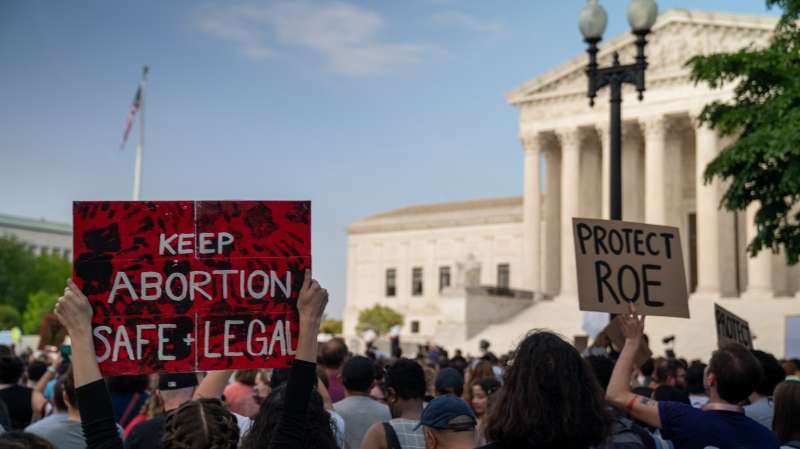
At a recent event on the fourth anniversary of the Supreme Court ruling overturning Roe v. Wade in June 2022, several women shared their abortion stories. That made me decide that I wanted to share my story, too.
There aren’t that many people in my life that I had told about my abortion. It’s so personal, and I didn’t want to be judged. But hearing these other women talk about their abortions made me realize that I don’t need to be ashamed.
I’m done with that. I will not be shamed. And with Trump’s Attorney General Todd Blanche talking about making abortion illegal in every state, passing Question 6 is essential. We need to enshrine the right to abortion into Nevada’s Constitution. That’s our best protection to preserve our reproductive rights here.
Editor’s note: Blanche said the administration was working toward making the Dobbs decision “permanent in every single state.” The Justice Department said afterward that his comments concerned mail-order abortion medication rather than broader federal action affecting state abortion laws.
READ MORE: 5 ways to support reproductive freedom across Nevada