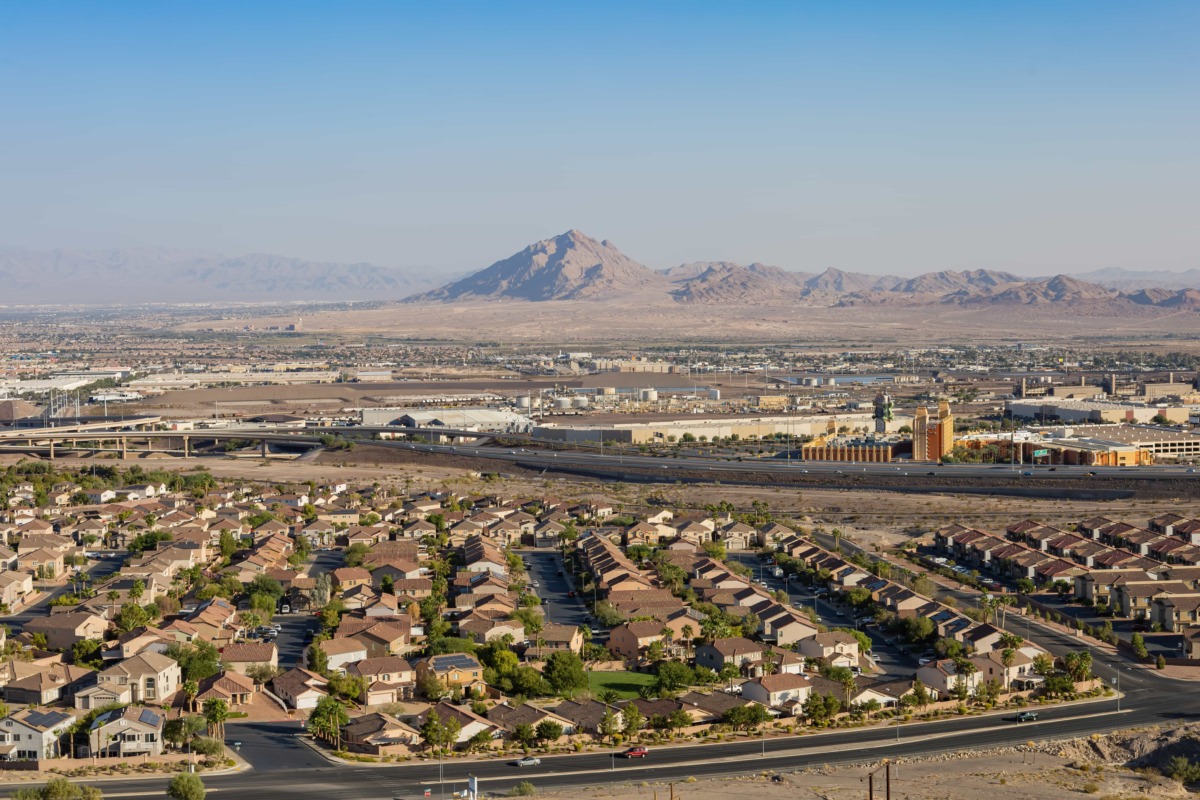
Las Vegas real estate is also taking a huge hit with an over 10 percent decline in year-over-year sales, and Inventory has skyrocketed by 44.8 percent. (Photo by Justin Sullivan/Getty Images)
Accessory dwelling units have vocal backers in Nevada, but the experiences of other states casts doubt on whether they can solve the housing crisis.
Hundreds of thousands of people have moved to Nevada since the pandemic, and with that population boom expected to continue over the next 35 years, lawmakers are focused on increasing affordable housing in dynamic ways.
One approach involves authorizing accessory dwelling units (ADUs), or tiny homes.
These structures, although already approved in several municipalities, have recently gained renewed focus with the passage of Assembly Bill 396, which requires counties with over 100,000 residents and cities with more than 60,000 residents to adopt an ordinance permitting ADUs on residential properties by July 1, 2026.
ADUs are defined as “independent living spaces” that are built on the same piece of land as the primary residence and are either attached or detached to the primary residence, or built within it. ADUs must include a kitchen and must “meet all applicable building codes, housing codes, and any other codes regulating the health and safety of residential property.”
If jurisdictions miss the deadline, ADUs will be allowed “on any parcel zoned for residential use without restriction,” excluding areas under the control of regional planning agencies.
ADUs have been authorized across states and cities as leaders seek solutions to a worsening national housing crisis, and supporters, including Democratic Assemblymember Shea M. Backus, who sponsored Assembly Bill 396, view ADUs as a means to increase affordable housing in Nevada. She stated during a May meeting of the Senate Government Affairs Committee that ADUs would “supplant” other housing production.
But research from other states like California found ADUs are “usually priced at or above market rates” and can cost several thousand dollars per month to rent, making them unaffordable for many renters and casting doubt on their ability to solve Nevada’s housing crisis.
Local officials are also skeptical that changes to zoning codes to allow more ADUs will amount to substantially more affordable housing.
“Allowing them is one thing,” said Seth Floyd, director of community development at the City of Las Vegas. “But people developing them on their properties is another.”
ADUs have been permitted in Las Vegas for “a long time,” according to Floyd, which often surprises people due to the low supply. Since October 2023, there have been only 12 applications for ADUs in Las Vegas, Floyd wrote in an email.
North Las Vegas also already authorizes ADUs, as does the city of Henderson, which updated its code in 2022, according to city officials. North Las Vegas, which has had just four applications since 2022, is reviewing AB 396 to determine what changes should be made, according to an email from their public information officer, Liz Abebefe.
Henderson will also make another update in November to mirror the state’s definition of ADUs, a city spokesperson wrote in an email. Reno is also working to adopt an ADU ordinance in compliance with the new state law. This comes after the city put forth a failed measure in 2018, reports the Nevada Current.
According to Maurice Page, executive director of the Nevada Housing Coalition, the ideal occupants for ADUs include college students, early-career professionals, veterans, individuals with disabilities, and low-income workers. But homeowners are reluctant to expand their residential neighborhoods, Page said, which makes even the ones who build ADUs less likely to rent them to tenants. He labeled this a form of “not in my backyard” (NIMBY) groupthink.
“[Homeowners] don’t understand growth overall,” Page said. “They have a neighborhood that they see as fine for where it’s at.”
He said people have voiced concerns about the maintenance of ADUs, expressing worry they could become an eyesore in the community and bring down property values.
Other factors also contribute to a low supply, including the costs of building and permitting, and covenants in master-planned communities.
“There’s a few challenges with building them, which really doesn’t have that much to do with the city’s regulations,” Floyd said.
In Las Vegas, the special-use permit to build an ADU, which includes a notification fee— the cost associated with alerting the public about a potential neighborhood change—is $800. This is needed to begin construction, and the fees don’t stop there. Homeowners looking to build ADUs are also responsible for paying building permit fees for inspections on top of the cost to build or buy a small home.
“They can be expensive because you’re essentially building a small home on your property,” Floyd said.
According to Floyd, should ADU development increase in the Las Vegas Valley, it’ll be in “the urban core” or wards with fewer master-planned communities and areas not under the jurisdiction of Homeowner Associations (HOAs). He listed Wards 1, 3, and 5 as being most likely to see more ADUs.
“But we’re not seeing a whole lot of applications in those neighborhoods either,” he said.
Could ADUs help historically redlined communities?
While skepticism about ADUs abounds, supporters remain convinced of the model’s potential.
Democratic Assemblyman Jovan Jackson views ADUs as an opportunity for fostering economic empowerment in redlined communities, which helped motivate his push for Assembly Bill 131. From his perspective, additional homes on lots could provide more housing for people living in multigenerational households and increase property values in formerly segregated neighborhoods.
“I felt that this [bill] was a way to streamline … ADUs on these historical properties that have big front yards, backyards,” Jackson said. “We could bring equity to communities that’s been redlined and … missed out on getting equity, like the rest of the valley.”
Jackson represents District 6, which overlaps with Las Vegas Wards 3 and 5, and includes several historically Black communities in Clark County. He introduced a bill that would streamline the process to build ADUs by eliminating the required public hearing before local governing bodies. Homeowners looking to build ADUs must currently present their proposals before these local bodies, such as city councils.
“That’s intimidating, especially for an older person that may not even be mobile,” Jackson said.
After strong opposition from city and county officials, Jackson said he did a gut-and-replace for Assembly Bill 131 and focused instead on providing property tax exemptions for ADUs leased to tenants receiving federal housing assistance through Section 8 vouchers. That bill was passed unanimously by the Assembly, but it died in the Senate Finance Committee without a hearing.
Jackson said the bill had support from community members and would benefit homeowners and renters.
He might bring the bill back in the next legislative session in 2027 and create limits on the number of ADUs that can be rented to Section 8 recipients, if needed.

A renter’s guide to the cheapest areas in Nevada
Looking to save on rent? It may be time to move to one of these eight Nevada towns, the cheapest areas for renters in the Silver State. We’re number...
Home sale profits dwindling but still above pre-pandemic levels, says report
By Dana Gentry, Nevada Current Nevada home sellers are holding their own in this buyers’ market, reaping profits slightly above the national...

Inversionistas corporativos son dueños de una de cada cinco viviendas en Las Vegas
Por Suzanne Potter Este artículo fue publicado originalmente en inglés. Uno de cada cinco hogares en Las Vegas ya no pertenece a familias, sino a...
En Nevada, la industria del turismo sostiene la economía, pero no a sus trabajadores
Para recibir contenido en español directo a tu email, suscríbete al boletín Vegas Somos Las Vegas, Nevada. La postal es conocida: luces de neón,...
Nevada’s biggest industry can’t afford to live
Leisure and hospitality workers in Nevada struggle to make ends meet. With average rentals climbing to around $2,000 a month—and landlords requiring...

City of Las Vegas offers lead paint and drip repair services to homeowners
The City of Las Vegas is offering qualifying residents with young children lead paint removal and financial help to fix leaks in their homes. The...