If you’ve never struggled to put food on the table, it may seem incomprehensible that many of your fellow Nevadans do.
The fact is, it’s a significant problem in the Silver State, with 15.1% of the state’s population facing food insecurity, more than the national average of 14.3%, according to the Kenny Guinn Center for Policy Priorities (Guinn Center). The nonprofit Feeding America reports that in the Silver State, 481,460 people face hunger; 136,580 of whom are children.
That’s one in seven Nevadans with no idea where their next meal will come from.
A primary driver of food insecurity in the state correlates with where you live. According to the United States Department of Agriculture (USDA), Nevada has 40 food deserts, which are areas with limited or no access to nutritious and affordable food options like fruits, vegetables, and whole grains.
While this often applies to low-income areas, it is also due to a lack of transportation, such as a lack of personal vehicles or nearby bus routes, and to rapid urban growth that leaves older neighborhoods in the dust. It also tends to coincide with housing instability, health challenges, and a lack of public assistance.
Food deserts exist in multiple counties throughout the state. In Southern Nevada, Clark County is home to about 97% of the food-insecure, in neighborhoods including the Historic Westside, downtown, south of Harry Reid International Airport, the area surrounding Nellis Air Force Base, and along the Boulder Highway corridor.
Northern Nevada’s food deserts include parts of the North Valley and Pyramid Lake.
The problem is especially prevalent in remote counties like Esmeralda, Nye, and Mineral, with food insecurity affecting 20% of the population, compared with 15% in Clark County, according to the Guinn Center.
Fortunately, several local nonprofits, government entities, and retailers are actively working to address this issue. But even with these efforts, issues remain.
What makes a community food insecure?
According to the College of Agriculture, Biotechnology, and Natural Resources at UNR, the primary drivers of food insecurity are a lack of easily accessible, nutritious food and uncertainty about where to obtain it in a socially acceptable way, rather than through scavenging or resorting to emergency food supplies.
Neighborhoods that are food-secure, on the other hand, meet certain standards for the availability, accessibility, affordability, and appropriateness of food. Failing to meet even one of these standards is enough to make a neighborhood food insecure.
Some neighborhoods become food-insecure abruptly after the grocery store they rely on closes. The northeast Las Vegas neighborhood near the Air Force base, for example, was abandoned by a longtime Wal-Mart superstore in 2016, leaving residents, many of whom don’t have cars, with no choice but to shop at convenience stores or spend several hours of their day riding a bus to and from the closest supermarket.
Though the East Las Vegas neighborhood welcomed a joint grocery store-food pantry, The After Market, in 2023, and hydroponics nonprofit Green Our Planet is building its permanent headquarters there, the problem remains.
In a paper about food deserts of Las Vegas for UNLV, Higher Education Professional and Urban Researcher David Sinclair confirms that food retailers, primarily big-box stores, “control massive distribution chains and employ armies of workers who help deliver food from farms to their stores, meaning that, in addition to creating food deserts, they also leave an economic vacuum behind them whenever they close up shop.”
Three Square reports it would take 57.8 million meals a year to meet the current need for food in our communities, even with food and resources made available through federal nutrition programs and charitable organizations.
The human toll of food insecurity
Southern Nevada residents who are food insecure miss nearly 72 million meals a year, which is about 190 skipped meals per person, or 6.3 meals per week, according to Three Square Food Bank. Additionally, about 495,800 Nevadans received SNAP benefits in 2025.
The burden of food insecurity is felt disproportionately by people of color, with 21% of Black communities and 19% of Hispanic communities exhibiting high levels of food insecurity, according to the Guinn Center. The most significant food insecurity is with American Indians and Alaska Natives, about 25% nationally.
It’s also a big problem for older adults due to fixed incomes, declining health, less social support, and lack of transportation. About 10.7% of seniors eat smaller meals or skip meals entirely every month to save money.
Research shows that hunger takes a significant toll on the health of Nevadans, causing higher rates of hypertension, diabetes, and depression, along with increased developmental delays in children.
Food insecurity caused over $518 million in associated healthcare costs for the state in 2022, per the Guinn Center. A 2023 study showed that 41% of food-insecure high school students exhibited depressive symptoms, compared to 20% of their food-secure peers.
While it’s easy to get bogged down by the numbers, the nonprofit Just One Project helps put a face on the problem, providing some examples of what food insecurity might look like in your community:
- Families skipping meals to stretch their budget
- Seniors choosing between groceries and medication
- Adults who work yet have no affordable food options nearby
- Children whose only meal is school-based
Addressing food deserts in Nevada
Nonprofits, food banks, gardens, & mobile distribution
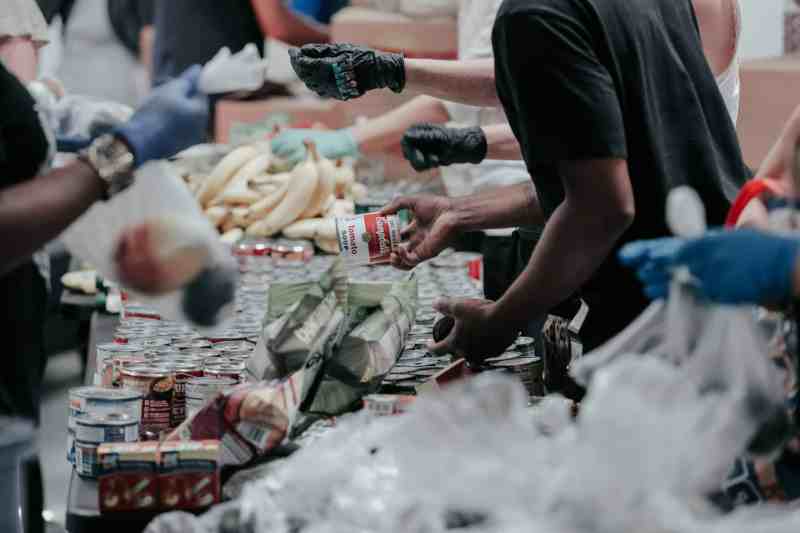
Whether you want to lend a hand at a Nevada food pantry or start a community garden, there are lots of ways to get involved in the fight for food security. Many local organizations are addressing hunger, feeding the hungry, and raising awareness about the lack of food resources in Nevada, including:
- The Food Bank of Northern Nevada: Works with partner agencies to provide access to food for children, seniors, and adults
- Three Square Food Bank: The largest hunger-relief organization in Southern Nevada.
- The Just One Project: A nonprofit that provides mobile food distributions of fresh, nutritious groceries
- The Community Health Alliance: Operates food pantries throughout Reno and Sparks as part of its greater healthcare mission
- The Southern Nevada Food Council and The Northern Nevada Food Council: Advocates for policy and systems changes to strengthen the food systems in Nevada.
- Gardening nonprofit Soulful Seeds organizes and operates USDA Certified gardens across Washoe County, creating a hyper-local food distribution system.
- The University of Nevada Cooperative Extension trains volunteers and grows produce to donate back to Nevada communities through its “Master Gardener” program.
- Green Our Planet: Helps Nevada schools build and operate gardens so they can grow and sell food, connect with nature, and feed the community
Government support
While the USDA canceled funding for popular locally grown food programs in Nevada last year, work is still underway to address hunger through local government agencies such as the Office of Food Security and the Nevada Council on Food Security (CFS). In 2025, Nevada lawmakers passed a bill, SB 282, which directs the Department of Health and Human Services to award grants to urban and rural grocery stores in food deserts.
In her State of the City address earlier this year, Las Vegas Mayor Shelley Berkley mentioned plans to open a grocery store in Downtown Las Vegas as part of a Symphony Park development.
In the Historic Westside, longtime grocery store Mario’s Westside Market partnered with the City of Las Vegas, the county, and others to expand their inventory of health food options in 2023.
This article first appeared on Good Info News Wire and is republished here under a Creative Commons license.
Related: 12 Nevada food pantries to donate your time, money, and food to this holiday season