
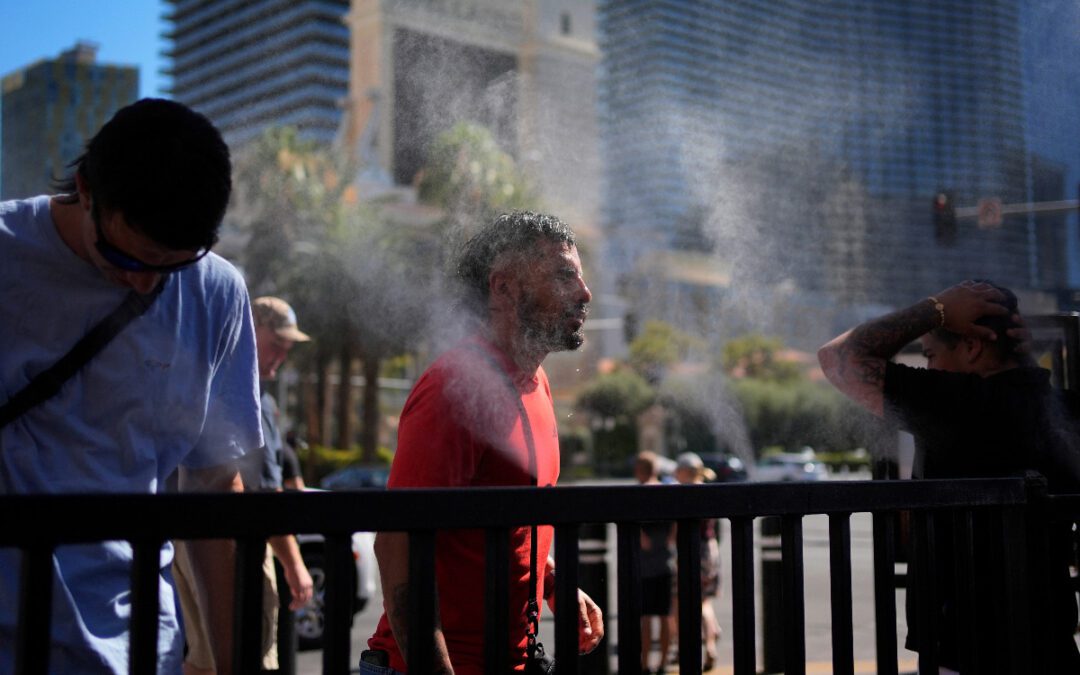
A man walks near the Las Vegas strip during a heatwave in Las Vegas, Nevada on July 7, 2024. (ROBYN BECK/AFP via Getty Images)
Nevadans are used to triple-digit heat pushing their power bills higher and higher, but not everyone knows what decisions lead to those price increases, and that the state’s energy monopoly doesn’t often get any pushback.
With another record-breaking heat wave arriving before winter ends, NV Energy has a ready excuse to ask for more rate hikes—and the commissioners hand-picked by Gov. Joe Lombardo have already shown they’re willing to give the utility hundreds of millions in new revenue. That’s what this story is about: how a winter heat wave, a monopoly utility, and a governor’s appointees can add up to higher bills for every Nevadan. And once you understand how it works, you’ll know what power you have to change it.
What you need to know about recent events
Earlier this year NV Energy had to pay back roughly $63 million in settlement money to over 108,000 customers who were overcharged by nearly $65.5 million throughout the course of many years. NV Energy is the utility company that provides electric service to most of the state.
NV Energy admitted to overcharging those customers—but then they won approval for a “daily demand” fee that can spike bills based on a household’s worst 15 minutes of usage, and secured hundreds of millions of dollars in new revenue.
They got all those things from a commission entirely appointed by Republican Gov. Joe Lombardo, whose campaign and post-election war chest directly benefited from utility and corporate money.
On July 7, 2024, temperatures of 120 degrees were recorded at Harry Reid International Airport, blowing past the previous record of 117. Las Vegas reported a straight week of scorching weather, with temperatures at or above 115 degrees.
Temperatures at Reid International are forecast to hit 98 degrees before our current winter ends (first day of spring is officially March 20), and Nevadans could see this year’s heat wave hit their wallets by the end of 2027.
It happened in 2024, and there’s evidence that it’ll happen again. The real question is, will the governor do anything to prevent it?
Who you pick for governor directly impacts what you pay for utilities
Higher temperatures push Nevadans to lean on the services provided by NV Energy to stay safe. And if NV Energy wants to increase rates, the company must file a rate increase request with the Public Utilities Commission of Nevada (PUC), a state government agency that oversees utility pricing.
The PUC is made up of three commissioners, all appointed to four-year terms by the governor—which is just one way the governor’s race impacts Nevadans’ pocketbooks.
NV Energy donated money to Lombardo after he won his election. It’s not necessarily bribery or a quid pro quo—businesses often give money to a politician to build political clout.
In this case, NV Energy donated to Lombardo, Lombardo appointed commissioners, and his appointees now keep awarding the monopoly decisions that help it turn extreme heat into profits.
In 2023, Lombardo reappointed Commissioner Hayley Williamson as chair of the PUC. Lombardo also appointed Randy J. Brown in 2023, and reappointed Tammy Cordova in 2024.
Then, in 2025, NV Energy asked for a rate hike that would increase its revenue by around $224 million, along with a daily peak demand charge for residential and small business customers, according to reporting from the Nevada Current.
The all-Lombardo commission approved roughly two-thirds of NV Energy’s request.
Advanced Energy United, a group that represents renewable energy providers, claimed that the daily demand peak charge could result in higher energy bills for all customers and “put Nevadans at risk.” Indeed, nearly 1,500 heat-related deaths were reported by the Clark County coroner in the last five years combined.
Nonprofit groups including Vote Solar have sued the PUC, arguing commissioners overstepped their authority in NV Energy’s rate case, undermined rooftop solar investments, and approved a rate design that unfairly penalizes customers for short spikes in usage.
The Attorney General’s Bureau of Consumer Protection has also raised concerns about the consumer impacts of the new rate structure, and joined other intervenors in seeking reconsideration of parts of the decision.
The daily demand peak charge was scheduled to go into effect on April 1, but got pushed back to Oct. 1.
Does it have to be this way?
Nevada isn’t the only state in the US to deal with the risk of rising utility price increases, nor is it the only state that has to deal with a public utility monopoly.
California gubernatorial candidate Tom Steyer made it a core plank in his platform to break up Pacific Gas & Electric.
New Jersey Gov. Mikie Sherrill signed an executive order to direct their version of the PUC to pause rate hikes and use state funds to offset expected summer increases.
Lombardo has the ability to use his executive powers as governor to protect families in Nevada, but instead he’s allowing a monopoly utility and his commissioners proceed with rate hikes.
What you can do about it
Over the next two years, Nevadans aren’t just bracing for hotter summers and stranger winters—they’re bracing for the bill from a monopoly that overcharged them, a governor it helped elect, and regulators he hand‑picked to keep saying yes.
Each extreme heat event forces people to keep the AC running longer, which makes it easier for one bad 15-minute window to make the bill unaffordable for the entire month.
Lombardo is up for reelection this year, and the next governor will decide who gets to sit on the commission that rules on the next round of NV Energy proposed rate hikes.
With temperatures already flirting with 100 degrees before winter ends and another brutal summer on the horizon, the question for voters isn’t just how hot it will get—it’s how much longer they’re willing to pay for a system where a politically connected utility, a friendly governor, and his hand‑picked regulators keep turning climate crisis into a business model.
Nevada’s statewide primary elections take place on June 9, and general elections take place on Nov. 3. Find your voting options here.

As Colorado River nears collapse, it faces leadership, transparency ‘crisis,’ environmentalists warn
This article originally appeared on Inside Climate News, a nonprofit, non-partisan news organization that covers climate, energy and the...
This bill would require some Nevada cities to better protect residents from extreme heat
Five cities in Nevada may soon be required to take more measures to help protect residents from deadly heat. If Assembly Bill 96 becomes law, any...
Trump’s Executive Orders Could Raise Energy Costs and Threaten Jobs in Nevada
Nevadans could soon feel the pinch in their wallets and job prospects thanks to recent actions by President Donald Trump. A report shows that...

More than a dozen NPS workers fired from Lake Mead as part of mass federal workforce purge
The positions eliminated include park rangers, engineers, ecologists, maintenance workers, and cultural resource staff for the ninth most-visited...

Condena Chispa Nevada el retiro de apoyo en su pago de electricidad a familias de bajos ingresos
Chispa Nevada condena que la administración Trump retire ilegalmente el financiamiento del programa de Nevada para reducir las facturas de...

Biden admin moves to shield Nevada public lands from mining with support of tribes, local leaders
In one of President Biden’s last moves in office, his administration has moved to protect 269,000 acres of public land in Nevada from a proposed...