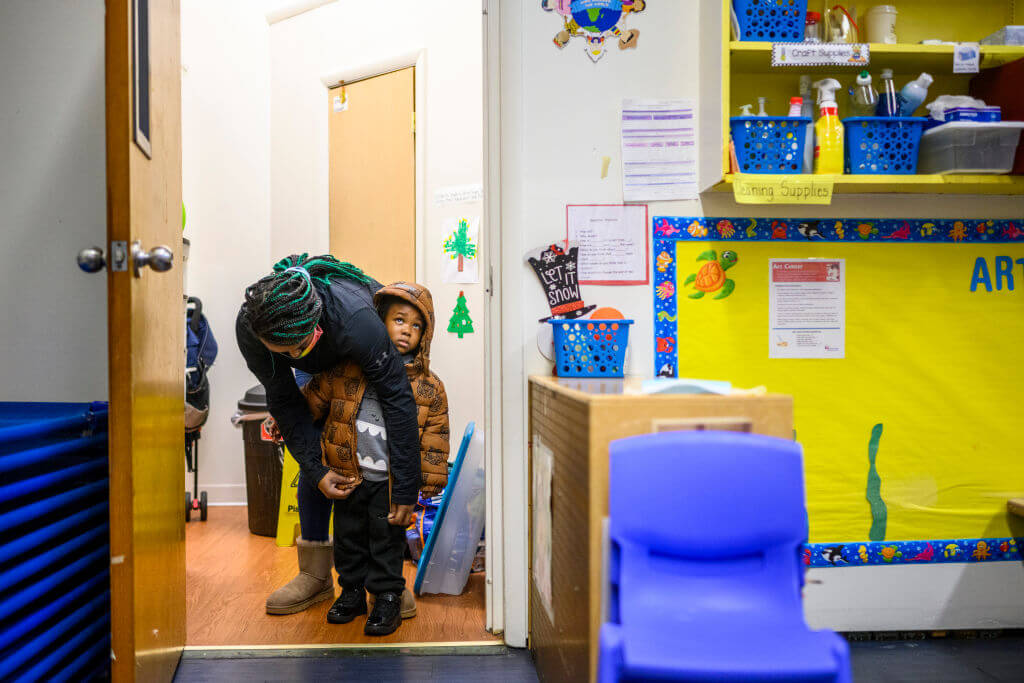
Photo by Matt Roth for The Washington Post via Getty Images
WASHINGTON (AP) — Democrats in Congress are pushing for a new round of money to keep the nation’s child care industry afloat, saying thousands of programs are at risk of closing when federal pandemic relief runs out this month.
Legislation introduced in both chambers on Wednesday would provide $16 billion a year over the next five years, awarded as grants to help child care programs cover everyday costs. It’s meant to replace $24 billion in relief that was passed in 2021 in the American Rescue Plan and is set to expire Sept. 30.
With no Republican support, the bill faces an uphill battle in Congress.
Without a new lifeline, child care programs serving millions of families could close or increase prices. For many, the federal aid only postponed the financial turmoil that threatened their survival before the pandemic.
“There was a child care crisis even before the pandemic — and failing to extend these critical investments from the American Rescue Plan will push child care even further out of reach for millions of families and jeopardize our strong economic recovery,” said Sen. Patty Murray, D-Wash., a sponsor of the bill.
Other sponsors include Sen. Bernie Sanders of Vermont and Rep. Katherine Clark of Massachusetts.
A June report from The Century Foundation found that without additional money, about 70,000 child care programs would probably have to shut down after this month. That amounts to a third of all programs that received the federal pandemic grants. States distributed the aid in different ways, and many providers already have spent their grants. Either way, the last of it must be spent by Sept. 30.
In total, the programs in jeopardy serve about 3.2 million children.
RELATED: Nevada families face child care crisis as federal funds set to expire
Hoping to buffer the industry against the upheaval of the pandemic, Congress created a child care stabilization program in 2021. States were given a total of $24 billion to distribute to local programs. It helped more than 220,000 programs, often being used to pay staff or cover rent and utilities, according to the Department of Health and Human Services.
The grants helped Cynthia Davis keep her child care center open through the pandemic, serving eight children at her home in Washington, D.C. When the economy stalled, income stopped coming in. Davis used her personal savings to pay staff and buy safety supplies. She was nearing the end of her savings when she received about $70,000 in federal grants and other relief.
“It really was a breath of fresh air for a lot of us, because those dollars gave me money I could put back into my savings and my retirement,” she said.
Still, inflation and safety costs have taken a toll. Davis had to lay off one worker, leaving her with just one other. Without more relief, she figures her center will close within a year.
“I just don’t know what’s going to happen to a lot of programs,” she said. “We already are stretched to the limit.”
The money was seen as a steadying hand for an industry that badly needed it. In the first two years of the pandemic, about 20,000 programs closed, roughly the equivalent of 10% of pre-pandemic levels, The Century Foundation said.
But even before then, the industry was struggling. The number of providers has been on the decline for years as workers fled the industry and its persistently low pay. Yet demand has remained high, pushing programs to raise prices and, in some places, resulting in child care “deserts” where demand far exceeds available spots.
The average annual price for US child care in 2022 was $10,800 per child, according to Child Care Aware of America, a nonprofit advocacy group.
President Joe Biden has called for expanded child care support, but his biggest proposal stalled amid opposition from all 200-plus Republicans in Congress and a handful of Democrats.
Under Biden’s Build Back Better Act in 2021, parents earning up to 250% of a state’s median income would have paid no more than 7% of their income on child care. But that that bill failed to win support from Democratic holdouts, Sens. Joe Manchin (D-WV) and Kyrsten Sinema (D-AZ), and the child care plan was later stripped from a slimmer package approved by Congress.
In a statement, Clark said the pandemic relief allowed parents to return to work and paved the way for economic recovery.
“We can’t turn back now,” she said. “Child care is economic infrastructure — it is critical to growing the economy by growing the middle class.”

School choice and low funding create enrollment vacuum for Nevada public schools
As the educational landscape adjusts to structural changes like reduced federal funding, expanded school choice, and charters, enrollment in...

Bright windows and working AC: Woodbury Middle School debuts new campus
The new campus is a result of CCSD’s replacement school program where a school is demolished and rebuilt but CCSD will be pausing new schools...

Qué saber para el regreso a clases en CCSD
Esta nota apareció primero en el boletín Vegas Somos, suscribete aquí. El 11 de agosto es el primer día de clases en el Distrito Escolar del Condado...

Back-to-school fairs in the Las Vegas area (July 26-Aug 9)
There are several back-to-school fairs in the Las Vegas area ahead of the first day of school on Aug. 11—many offering free supplies, CCSD...

Back to class: What to know for the 2025-2026 Nevada school year
This story appeared in The Nevadan newsletter, subscribe here. The first day of school in Nevada is Aug. 11. Here are some reminders and things to...

Lombardo supports Trump’s executive order to dismantle education department
Nevada Attorney General Aaron Ford called out Lombardo for supporting the elimination of the Department of Education, claiming the governor “sold...