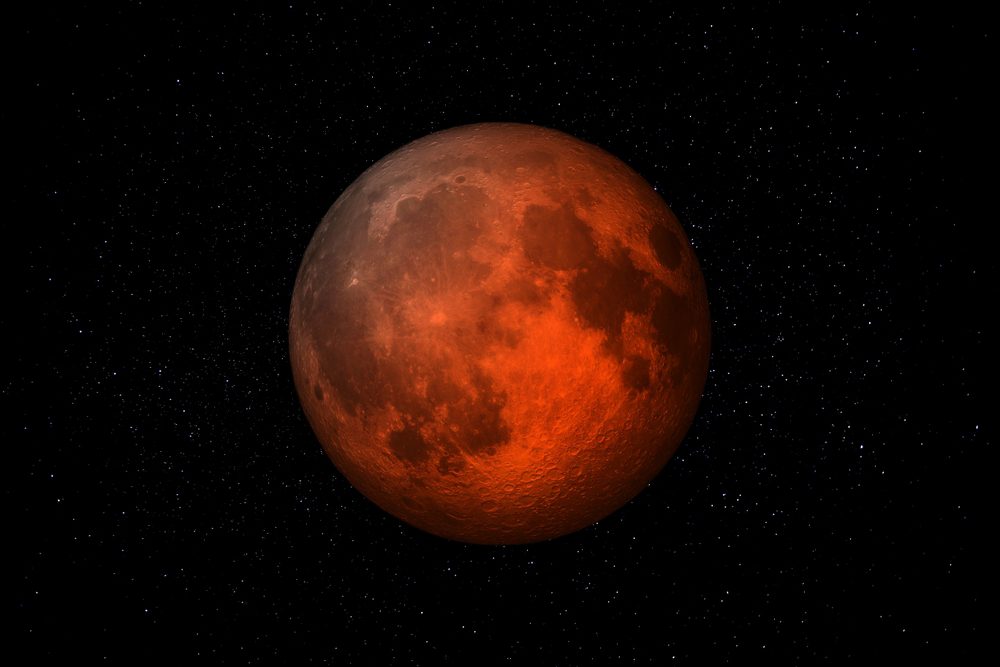
Blood moon during a total lunar eclipse. (24K-Production/Shutterstock)
By Jennifer Sangalang, Reno Gazette Journal
A lunar eclipse is on its way in a little less than a week. By early March, Nevadans should be able to see the rusty red moon in the night skies if the weather permits.
Lunar eclipses are different from solar eclipses. During a solar eclipse, the moon passes between the Earth and the sun, casting a shadow onto the Earth. In a lunar eclipse, the Earth casts its shadow on the moon, creating a rusty red hue.
However, the downside in viewing a lunar eclipse is that you’ll have to be up very late — or very early, depending on your perspective — to see it.
Here’s everything you need to know about the upcoming lunar eclipse and how to see it in Nevada.
What eclipse is in 2026?
If you live in the U.S., you will be able to see the lunar eclipse starting at 12:44 a.m. PST Tuesday, March 3, 2026, according to NASA. During the night, you’ll see the moon in a reddish hue, or a blood moon.
Totality lasts for a little more than an hour before the moon begins to emerge from behind Earth’s shadow, according to the popular site timeanddate.com. As the moon moves into Earth’s shadow, also known as the umbra, it appears red-orange or a “ghostly copper color,” hence its name: blood moon, NASA says.
“During a lunar eclipse, the moon appears red or orange because any sunlight that’s not blocked by our planet is filtered through a thick slice of Earth’s atmosphere on its way to the lunar surface,” NASA says. “It’s as if all the world’s sunrises and sunsets are projected onto the moon.”
The entire eclipse will last about six hours. People in Nevada can see the lunar eclipse during the early morning hours of Tuesday, March 3, 2026. The total lunar eclipse will be visible in North America, South America, Eastern Europe, Asia, Australia and Antarctica.
Everything will be over by 6:23 a.m. PST on March 3, 2026. Below is a countdown clock for the 2026 total lunar eclipse.
Where are the best places to see the lunar eclipse near Reno?
- Though the Biggest Little City has an abundance of light pollution, darker skies are less than an hour from Reno.
- Fort Churchill State Park: The park provides a dark night sky ideal for evening astronomical events among the ruins of Fort Churchill. Park entrance costs $5 for Nevada residents and $10 for nonresidents.
- Pyramid Lake: A popular spot for Renoites seeking a night of stargazing, the lake is less than an hour from The Biggest Little City. It offers beautiful natural wonders and dark skies that give a clear view of the lunar eclipse.
- Lake Tahoe: Multiple locations around the lake are excellent for stargazing that are less than an hour from Reno.
- Cold Springs or Hidden Valley still get light pollution from the Biggest Little City, but have clearer skies than the middle of town.
- Driving down the road on USA Parkway will likely also give you the dark skies to see the lunar eclipse without having to make a significant drive outside of town.
Carly Sauvageau with the Reno Gazette Journal contributed to this report.
USA TODAY Network via Reuters Connect

8 water-filled hikes within an hour of Las Vegas
Marvel at splashing waterfalls and flowing creeks on these hikes located a quick jaunt from Las Vegas. Sometimes, a rainy day can cast a dark cloud...

5 fan-favorite stops in the Nevada State Parks Passport
From gigantic ancient rock formations to the country’s largest alpine lake, here are five spots to stamp on your Nevada State Parks Passport. Nevada...

How to cool off in the Colorado River’s Black Canyon
Whether you choose to kayak, scuba dive, or swim, cool off downstream from Hoover Dam on the Black Canyon Water Trail, a 30-mile expanse of the...
Meet the hikers blazing a new trail on the Carson City to Canada Quest
Julianne Mahoney and Audrey Payne won the Carson City to Canada Quest and will hike 1,600 miles from the Nevada capital to the U.S.-Canada border....
¿Por qué adelantamos el reloj una hora en marzo y en qué fecha toca el cambio de hora este año?
Si sólo tienes unos segundos, lee estas líneas: El horario de verano (conocido como Daylight Saving Time, en inglés) inicia cada segundo domingo de...

Why are clocks set forward in the spring? Thank wars, confusion and a hunger for sunlight
By JAMIE STENGLE Associated Press Once again, most Americans will set their clocks forward by one hour this weekend, losing perhaps a bit of sleep...