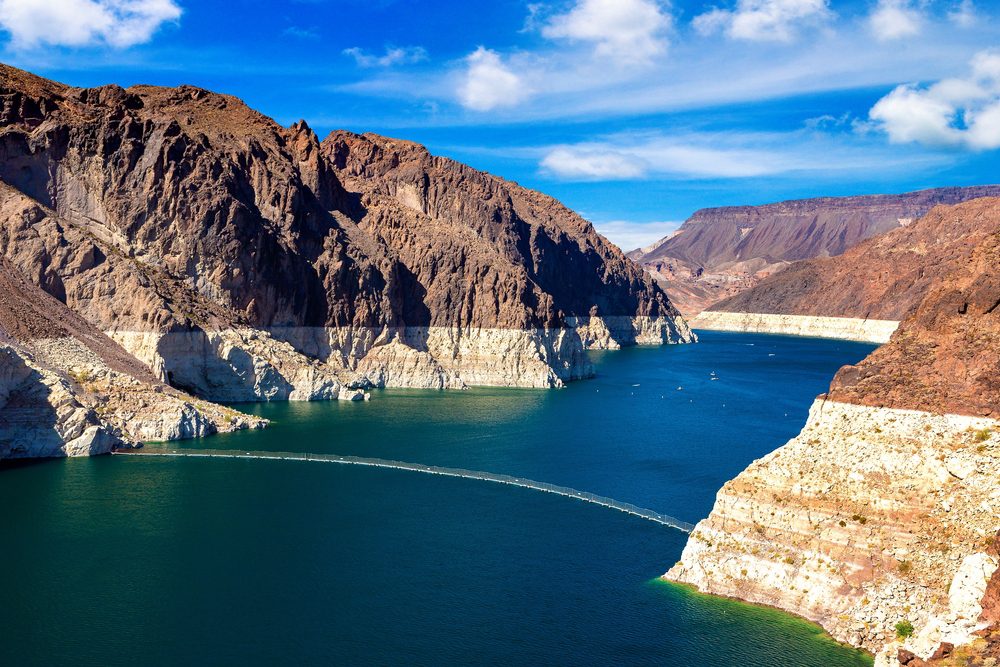
Colorado River as seen from the Hoover Dam. (Sergii Figurnyi/Shutterstock)
By Wyatt Myskow, Inside Climate News
This article originally appeared on Inside Climate News, a nonprofit, non-partisan news organization that covers climate, energy and the environment. Sign up for their newsletter here.
A new report from UCLA and the Natural Resources Defense Council found that large farms use nearly a quarter of Colorado River water and often pay little — sometimes nothing — for it.
Colorado River water is not priced at rates that accurately reflect its scarcity, incentivizing inefficiency and overconsumption as climate change and overuse threaten the vital waterway for 40 million people and 5.5 million acres of agricultural land across the Western United States and northwestern Mexico.
That’s the takeaway from a new report on water pricing in the Lower Colorado River Basin States—Arizona, California and Nevada—from the University of California, Los Angeles, and the Natural Resources Defense Council.
The researchers found that nearly a quarter of all water diverted from the river to agricultural irrigation districts in those three states is obtained for zero dollars from the federal Bureau of Reclamation, which oversees the river’s operations. Municipal water districts, on the other hand, pay an average of $512.01 per acre-foot, which is roughly the amount of water to supply two to three households for a year. Primarily agricultural water districts pay, on average, $30.32 per acre-foot.
The report also found that Colorado River water obtained through the Bureau of Reclamation is far cheaper than other sources of water, and that the price of the supply from the river largely stems from the cost of infrastructure to move it, rather than the value of the water itself.
“We are effectively giving away from the Colorado River millions of acre-feet per year, free of charge, or nearly free of charge,” said Noah Garrison, a co-author of the report and a water researcher at UCLA’s Institute of the Environment and Sustainability. “For a water system that is in crisis at this point, facing major shortfalls for one of the major sources of water for the entire Southwest United States, we simply can’t afford to be doing that anymore.”
The report comes as the Colorado River watershed endures the worst drought recorded in more than 1,200 years, which scientists predict will continue for decades to come due to climate change. Tense negotiations between the seven states that depend on the river to determine how much each will cut its water allocations missed a key deadline last month.
By far the biggest user of Colorado River water is the agricultural industry.
Preventing the collapse of the teetering Colorado River system urgently requires water prices to reflect the gravity of the situation, the researchers argue. Reclamation should implement a surcharge for the water it provides, the study says, which could cover operations, maintenance and repair costs for federal water infrastructure and help curtail use in Lower Colorado River Basin states.
A $100 surcharge, for example, could generate $600 million–$750 million per year for the Lower Basin and $1.2 billion–$1.5 billion per year if applied to all seven Colorado River states. That money could also go to local communities to invest in other water projects, such as installing more efficient irrigation systems or helping pay for advanced water recycling facilities.
The report also says the federal government should maintain a centralized database of water rights for supplies from various sources, including their prices and volumes, to help inform better water management decisions.
“We really cannot afford to leave any conservation tool off the table,” said Isabel Friedman, a co-author of the report and an environmental health advocate at the NRDC. “In a lot of ways, pricing is one of the most foundational conservation tools that we have in our artillery.”
Currently, water conservation in the basin has often come in the form of payments to farmers to not grow, Friedman added. The Imperial Irrigation District, one of the biggest and most powerful water rights holders, pays Reclamation nothing for the Colorado River water it uses, she said, but is paid almost $800 an acre-foot for water it conserves.
The difference in the price between ag and municipal water, Garrison explained, largely stems from how the system is designed. Water projects were built by the federal government to incentivize growth and aid farmers. Western water law is built on a system of prior appropriation, meaning users holding older rights get priority to the water in times of shortage. Across the West, those senior users are often farming operations. Municipal users, in some cases, have to buy their water rights from those more senior users, driving up the costs.
Another issue for municipal users: The Colorado River and its tributaries don’t flow through cities like Phoenix and Los Angeles, which instead have their water delivered by giant canal systems. The Central Arizona Project, for example, gets its water from Reclamation and then sells it to farmers and municipalities across the Phoenix and Tucson areas. Those users are really paying only for the cost of the infrastructure to move the water, the researchers argue, shifting the cost of the actual water to federal taxpayers.
The researchers obtained pricing data for surface water purchases for utilities, districts and municipalities in the Lower Colorado River Basin states and then narrowed the scope to review diversions of over 10,000 acre-feet and the end use of the water, along with the volume and price. The process took over a year.
Elizabeth Koebele, an associate professor of political science focused on water policy on the Colorado River at the University of Nevada, Reno, who was not involved with the new study, said its recommendations make sense but that there are political and systematic barriers to implementing its proposals, like the surcharge. Prices paid to entities like the Imperial Valley Irrigation District for water conservation aren’t for the water alone, she added, but for what farmers are foregoing growing with the water.
“It could be part of a broader reform of policies in the basin,” she said. “But I think on its own, it will face a lot of political pushback.”
The 1922 Colorado River Compact, which divided the river’s water between the Upper Basin consisting of Colorado, New Mexico, Utah and Wyoming, and the Lower Basin of Arizona, California and Nevada. A century later, water managers realized the river was overallocated due to the compact’s reliance on data from an unusually wet period in the region. Reclamation estimated there was around 18 million acre-feet (MAF) of water in the river, and each basin was allowed to take 7.5 MAF each. But in the 21st century, flows have averaged around 12.5 MAF a year, with studies predicting that will dwindle further and the most recent water year seeing just 8.5 MAF.
Drought mitigations implemented by the states and Reclamation to ease the water shortage, such as the Lower Basin states agreeing in 2023 to leave 3 MAF in the river for three years, are set to expire at the end of the year. Negotiations between the basins on how to share the diminished flow of the river are deadlocked, and the states missed a federally-imposed Nov. 11 deadline to come to an agreement, with a new deadline set for February.
But while the negotiators argue, water levels continue to drop at Lake Mead and Lake Powell, keystones of the Colorado River system and the country’s two biggest reservoirs. Studies show that if river water usage is not cut and the West sees a water year in 2026 similar to 2025, Lake Powell could reach “deadpool” in which Glen Canyon Dam is no longer able to generate hydropower and water is largely trapped behind it.
“Water pricing systems need to be a fundamental part of how we think about the future of the Colorado River and water in the West more generally,” Garrison said. “I don’t think we have the luxury of no longer including it in the ways that we address water shortage and drought.”

Trump’s Executive Orders Could Raise Energy Costs and Threaten Jobs in Nevada
Nevadans could soon feel the pinch in their wallets and job prospects thanks to recent actions by President Donald Trump. A report shows that...

More than a dozen NPS workers fired from Lake Mead as part of mass federal workforce purge
The positions eliminated include park rangers, engineers, ecologists, maintenance workers, and cultural resource staff for the ninth most-visited...

Condena Chispa Nevada el retiro de apoyo en su pago de electricidad a familias de bajos ingresos
Chispa Nevada condena que la administración Trump retire ilegalmente el financiamiento del programa de Nevada para reducir las facturas de...

Biden admin moves to shield Nevada public lands from mining with support of tribes, local leaders
In one of President Biden’s last moves in office, his administration has moved to protect 269,000 acres of public land in Nevada from a proposed...
Many fear help for Nevada water conservation will dry up under Trump
Despite billions from the Inflation Reduction Act going to benefit Nevada, President-elect Donald Trump and conservative fiscal hawks may pursue a...

Grant from Biden infrastructure law to help install 185 EV charges around Las Vegas valley
A $3.2 million grant from the US Department of Transportation will help fund and install electric vehicle charging stations in primarily...