
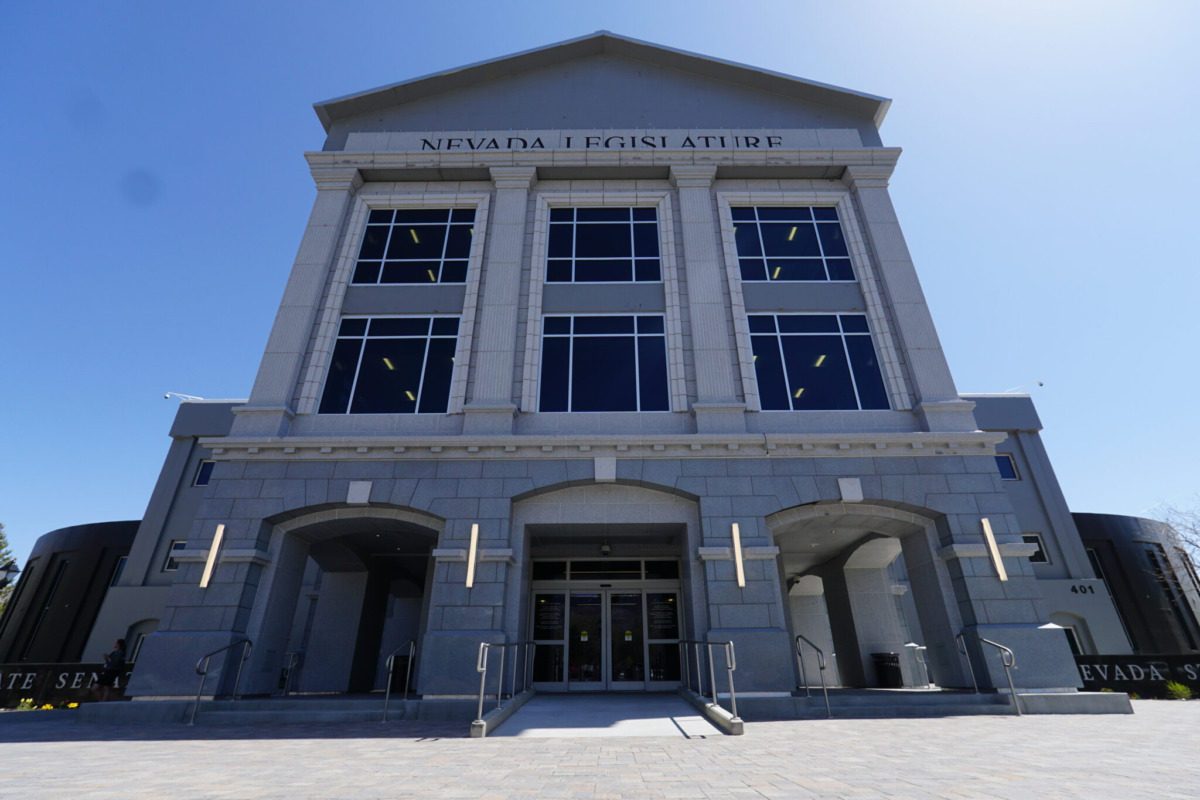
The Nevada Legislative Building in Carson City (Jeniffer Solis/Nevada Current)
By April Corbin Girnus
Food delivery apps will no longer be able to list restaurants on their platforms without first verifying those restaurants have business licenses and health permits, thanks to a new law that went into effect on Jan. 1.
It’s a change restaurants told lawmakers was needed because of an abundance of fake listings, wherein people impersonate restaurants on a third-party delivery app and sell their own food, often at lower quality and higher prices. Such imposter kitchens — sometimes called “ghost kitchens” — can damage the reputations of restaurants and potentially put people’s health at risk, the restaurants argued.
The new law, passed as Assembly Bill 116 during this year’s regular session, requires food delivery apps to verify that the restaurants they are listing have proper permits with their local health authority.
Unlicensed food establishments caught listing themselves on food delivery apps will be subject to a fine, as will any food delivery apps which don’t remove such listings once they are found to be in violation of the law.
The ghost kitchen crackdown stems from one of the dozens of bills that went into effect in the new year.
Another new law that went into effect supports and expand the number of rare diseases that newborns in Nevada are screened for.
Nevada is not currently in alignment with the U.S. Department of Health and Human Services’ accepted national standard for newborn screening. To help get the state there, Senate Bill 348 proposed increasing the fee that hospitals pay the Nevada State Public Health Lab for the screenings. The previous rate had remained unchanged since 2014.
Other health care-related bills that went into effect include: Senate Bill 138, which is expected to streamline the process of hospitals enrolling eligible women and babies into Medicaid upon delivery; Assembly Bill 163, which enters Nevada into an interstate compact that allows licensed professional counselors from other states to work here without applying for a separate license; and the “Right to Contraception Act,” which strengthens protections against a state or local government burdening access to contraceptive measures.
Also went into effect:
- AI disclosure AB73 requires that campaign advertisements and materials must, in “a clear and conspicuous manner,” disclose if they include images or audio generated by artificial intelligence. State lawmakers unanimously supported the measure during this year’s regular session, but its enactment may undergo further scrutiny in the upcoming year. The Trump administration this month issued an executive order promising a review of all state AI laws.
- Language accessibility AB367 strengthens the state’s language access laws for election materials. Ballots and other materials will be required to be available in more languages, including American Sign Language, and the state will be required to establish a toll-free telephone number where people can receive language interpretation for election-related materials.
- ID card program AB220 authorizes the Nevada Department of Human Services to establish a program to issue identification cards to Nevadans experiencing homelessness. The department is prohibited from charging a fee to the unhoused for the ID card.
- Air quality protections SB260 requires employers to notify workers when air quality is poor and limit outdoor work during dangerous conditions.
- Defendants deemed incompetent AB467 expands treatment options for defendants who have been deemed incompetent to stand trial. Specifically, it allows such defendants to be treated at private institutions instead of only at state- or county-run ones, which often have long wait lists.
- Foster care kids SB284 puts more parameters on child welfare agencies regarding how they deal with the federal benefits children in the agency receive. Among its provisions are requirements that the child welfare agencies check to see if children are eligible for benefits like Social Security. If they are eligible but not receiving them, the agency must apply for them.
- Bounce houses AB198 regulates the bounce house industry. The bill has been referred to as “Lizzy’s Law” after a 9-year-old Reno child who died after a bounce house operated by a rental company with no license or insurance was swept into a power line by a strong gust of wind in 2019.
Nevada Current is part of States Newsroom, a nonprofit news network supported by grants and a coalition of donors as a 501c(3) public charity. Nevada Current maintains editorial independence. Contact Editor Hugh Jackson for questions: [email protected].
Delays and fees complicate Nevada public records access
Even with robust public records laws in place, barriers still block lawyers and constituents from obtaining information from state agencies....
NV Energy asks PUC to delay peak demand charge start date
By Dana Gentry, Nevada Current NV Energy wants permission from the Public Utilities Commission to push back implementation of its controversial peak...
Who’s eligible for NV Energy $63M overcharge refunds? What to know
By Jason Hidalgo, Reno Gazette Journal NV Energy is preparing to reimburse overcharged customers after reaching a resolution with the Public...
Tesorero de Nevada pasa factura al gobierno federal por US$2.100 millones tras anulación de aranceles de Trump
Por Mark Robison, Reno Gazette Journal El tesorero estatal de Nevada, Zach Conine, envió este viernes una factura al gobierno federal por $2.100...
Nevada treasurer bills US for $2.1B after Trump tariffs struck down
By Mark Robison, Reno Gazette Journal Nevada State Treasurer Zach Conine sent a bill Friday to the federal government for $2.1 billion for a refund...
Nevada named among the worst places to drive in 2026
By Carly Sauvageau, Reno Gazette Journal Whether you’re trying to head to the North Valleys after 5 p.m. or make it out to USA Parkway during a...


