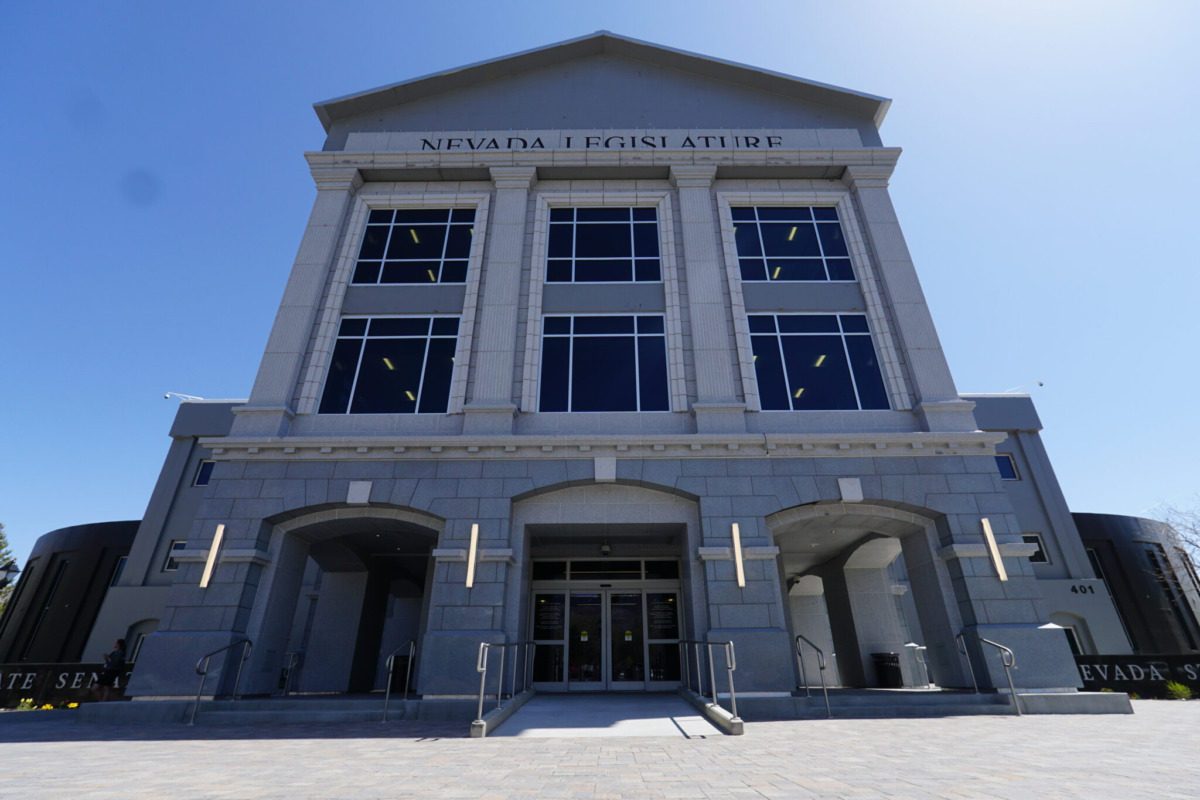
The Nevada Legislative Building in Carson City (Jeniffer Solis/Nevada Current)
Despite an affordability crisis against the backdrop of a severe housing shortage, lawmakers prioritize public safety, harsher penalties for petty crime.
The 36th Special Legislative Session, which began in late November, concluded with Nevada lawmakers facing mounting criticism for seemingly prioritizing special interests over public access.
On “extraordinary occasions,” the governor can call a special session through a proclamation, per the Nevada Constitution. On Nov. 12, Republican Gov. Joe Lombardo released his proclamation, which lists select policies up for a vote in the state Legislature starting the next day, along with dozens of funding allocations needing approval.
At one point, legislators limited public testimony to in-person only while allowing colleagues to cast approval votes by phone on the same bill. That happened when it came time to vote on a failed, controversial proposal, introduced for the third time, that would have created the largest tax cut in state history.
A rare bipartisan effort, Senate Bill 10, could have helped confront Nevada’s Bay Area-style housing crunch, but it collapsed just hours after its introduction. The bill sought to limit corporate home purchases to 1,000 annually. After it sailed through the Senate with unanimous support, it died in the Assembly, with every Republican present voting no.
Mid-session, dozens of immigrant-rights advocates rallied outside the Las Vegas Legislature, chanting and drumming to demand inclusion and denouncing an immigration study. This followed arguments that the organization’s immigration-focused amendments did not meet the adopted germaneness rule, which states that motions different than bills on the agenda won’t be considered. But immigration amendments were crafted behind closed doors anyway, leaving out some of the people closest to the concerns, advocates said.
Spanish-speakers were further disenfranchised when they sought to oppose Assembly Bill 4, or Republican Gov. Joe Lombardo’s revived crime package, which was passed and recently signed into law. Opponents, whose primary language is Spanish, were turned away from public testimony at the bill’s first hearing because no translators were available, even though groups had provided their own.
The governor’s crime bill was a central focus during the special session. Another high-profile policy discussed was Assembly Bill 5, which sought a $1.6 billion non-infrastructure tax credit for a Summerlin Studios Entertainment Complex in collaboration with Sony Pictures, Warner Bros., and Howard Hughes Developments.
“It seems as though a special session was called for … two specific industries,” said Tony Ramirez, lobbyist for the base building organization Make The Road Nevada, in an interview with The Nevadan-El Nevadense. “However, the one emergency that is impacting all of Nevada—whether it’s housing or our economy—is immigration.”
In exchange for the massive tax credit that major studios could then sell to other corporations, helping them save on taxes, was 19,000 construction jobs for Nevadans, career hubs in the struggling neighborhoods of East and West Las Vegas, and an expanded job industry. The proposal narrowly passed the Assembly but died in the Senate after failing to earn a constitutional majority.
On the other hand, Lombardo’s omnibus crime bill gained broad bipartisan support, making a wide range of changes, such as increasing penalties for violence against hospitality workers, DUI offenses, and possession of child pornography. It also improves re-entry programs and could establish “medication-assistance treatment” for prisoners seeking help with opioid addiction, if funds are available.
Lombardo’s first attempt at a massive crime package, which sought to undo Democrat-led criminal justice reforms during former Gov. Steve Sisolak’s term, was skimmed down significantly during the 2023 Legislature, reports the Nevada Independent. The governor brought a second sweeping proposal during this year’s regular session, but it failed sine die.
Lombardo’s recently enacted, extensive crime package also reauthorized Resorts Corridor Courts, or “one or more” tourism corridors in counties with 700,000 or more residents. The provision allows judges to ban low-level offenders from certain areas with a “high concentration of tourists, visitors, employees and other persons,” which has driven intense policy debates.
Athar Haseebullah, executive director of the American Civil Liberties Union (ACLU) of Nevada, slammed the bill, stating that it reestablishes a defunct system, created “at the behest of casino companies,” that targets the homeless. Key industry representatives in gaming and tourism testified in support of the bill, including those from the Nevada Resorts Association, Red Rock Casino Resorts, MGM Resorts International, Caesar’s Entertainment, and Wynn Resorts.
Democrats Assemblyman Max Carter and Senate Majority Leader Nicole Cannizzaro both said they support Lombardo’s crime bill 100% at a Hispanics in Politics meeting, despite critics’ claims that it fuels mass incarceration and power for elite industries.
“I think it’s always tough to get 100% consensus on bills … but I think on balance that bill did a lot of really great things,” Cannizzaro said.
Though housing is one of the state’s most pressing issues, it was largely neglected, aside from the passage of Senate Bill 6, an extension of the Windsor Park Environmental Justice Act. The measure added another $25 million to a relocation program for homeowners still living in a formerly segregated neighborhood sinking due to subsidence.
Despite Lombardo’s sweeping crime bill including some protections for immigrants, Leslie Turner, founder of the grassroots organization Mass Liberation Project Nevada, said the policy puts Democrats at risk, especially since they overwhelmingly backed the proposal.
At an ACLU of Nevada webinar about the crime bill, she said the policy’s success will “galvanize his base while at the same time, making our base disenchanted.”

Nevada lawmakers make wildfire coverage optional
The changes stem from an uptick in disastrous wildfires. A new Republican-led law—Assembly Bill 376—allowing homeowner insurance policies to exclude...

Nevada lawmakers’ concern over predictions betting grows
Could Nevada’s economy be at risk from online “commodity” betting? A high-stakes bet over who President Donald Trump will nominate as new chair of...

Activistas dicen que Nevada priorizó gestos políticos antes que protecciones reales para inmigrantes
Durante la sesión legislativa especial de Nevada en noviembre —instancia en la que los legisladores abordan asuntos urgentes o algunos cuyas...
Lawmakers debate proposed film studio bill: ‘For every dollar, we’d lose 77 cents’
By April Corbin Girnus The proposed Summerlin movie studio bill now under consideration by lawmakers in a special legislative session could force...
What could a major film studio investment mean for East Las Vegas?
A controversial film tax credit bill is being decided at Nevada’s special session. While it has detractors, local Latino leaders believe it will...
Gov. Lombardo calls Nevada special session for film tax credits, crime, much more
By Mark Robison, Reno Gazette Journal Gov. Joe Lombardo issued a proclamation Wednesday evening calling the Nevada Legislature into a special...