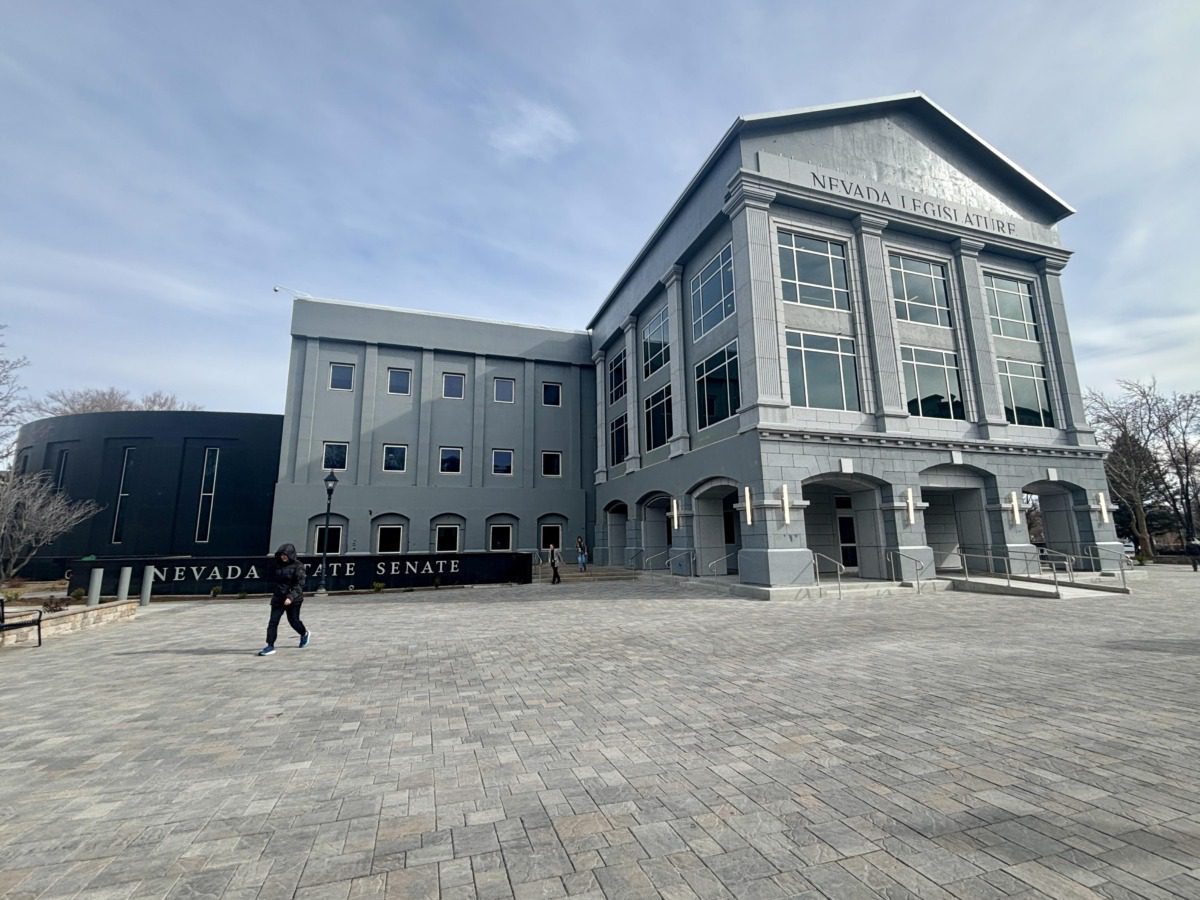
The Nevada State Legislative Building. (Casey Harrison/The Nevadan)
By Michael Lyle, Nevada Current
A bipartisan duo of state lawmakers hosted a webinar Monday to cast doubt on the merits of passing what would be the state’s largest public subsidy in history, a transferable tax credit plan that supporters hope to enact in an upcoming special session of the Nevada Legislature.
At the virtual forum Monday, Republican Senate Minority Leader Robin Titus and Democratic Assemblymember Natha Anderson said there are scant details about the proposal they are expected to vote on later this month.
A proposed bill would likely mirror failed legislation from the regular legislative session earlier this year that sought to allocate $1.4 billion in transferable tax credits over 15 years to support a studio in Las Vegas.
The legislation passed the Assembly by a razor-thin margin with 22 in support and 20 opposed. Lawmakers ran out of time and the bill never received a vote in the Senate.
“My members are saying, ‘Listen, I can’t give you an absolute until we see what’s in that bill,” Titus said, referring to the head count regarding which of her Senate Republican colleagues support the bill. “Right now, all this is speculation.”
Republican Gov. Joe Lombardo has vowed to call a special session. The details have been limited on the scope of what could be included, but supporters and opponents alike expect Lombardo to include the film tax credit bill sponsored by Democratic Assemblymembers Sandra Jauregui and Danielle Monroe Moreno in a special session agenda. Under the state constitution, when a governor calls a special session, they are allowed to determine what issues can and can’t be addressed by legislators.
How the film tax credit program works
Production companies can apply with the Nevada Film Office to receive transferable film tax credits equaling a certain percentage of qualified expenses.
The companies sell the credits to other Nevada companies at less than face value, though the state accepts them as payment at full face value.
The procedure provides a financial subsidy to the tax credit recipients (the tv or film production company), and a tax break to the tax credit purchasers (typically gaming or insurance companies).
The state incurs “negative revenue” — tax revenue that would otherwise fund services and programs is never received by the state.
Nevada’s film tax credit program is currently capped at $10 million per year. Jauregui and Monroe Moreno’s bill sought to raise that cap to $95 million per year, for 15 years, beginning in 2028. Hollywood giants Sony Pictures Entertainment and Warner Bros. Discovery is backing the measure, along with Howard Hughes Holdings, which would develop the site.
Titus, who declared her opposition to the proposal last month, even as the Republican governor has indicated he supports it, underscored during the virtual form Monday that the money for the program would be taken from state revenue “that would otherwise go to schools, and healthcare.”
In what resembled an impromptu unofficial legislative hearing, Titus and Anderson, both Northern Nevada lawmakers, invited Democratic Georgia State Rep. Marvin Lim to the webinar to question him about the economic impact and job creation, or lack thereof, of the film tax credit program approved in Georgia 20 years ago.
Lim acknowledged the differences between the two states but offered warnings for what lawmakers should look out for if considering allocating tax credits.
He said the film tax credit program has brought some economic benefits, but “it has come at a significant price and it is not sustainable.”
For all the grand gestures and promises by lobbyists to invest in local arts and the state economy, “this industry cares more about money than arts, communities, progressive values,” he said.
Beyond promises of raw job numbers, Lim encouraged lawmakers to take a deeper look at “what is the impact on the other parts of the economy?”
“How does this impact what the future of the industry will be, and how does that get sustained over the long run?” he asked. “If you attract all of these jobs, all of this talent, can this industry sustain itself over the long run?”
The economic advantages of the legislation have been questioned. An independent analysis commissioned by the Governor’s Office of Economic Development, which houses the Nevada Film Office, determined that the tax credits would stimulate the state economy but not enough to offset the massive expansion of the film tax credit program.
Lobbyist groups, including a political action committee set up by building trades unions, contend the public subsidy to California film corporations would lead to job growth.
The unions’ Nevada Jobs Now! PAC recently sent out mailers targeting lawmakers who have voted against the bill for not wanting to bring “more jobs.” The PAC’s ads reference neither the publicly subsidized film tax credit or even the film industry itself.
In Georgia, there were jobs created at the beginning, Lim said. But there hasn’t been any indication, or concrete data, on whether those jobs were sustainable, offered a living wage, led to other opportunities within the industry, or otherwise lived up to the promise made to Georgia lawmakers back in 2005.
All those questions have been met with “a huge, doubtful question mark,” he said.
In a statement Monday night, issued through the unions’ Nevada Jobs Now PAC, Monroe Moreno said the Georgia bill and Nevada’s proposal “could not be more different.”
Monroe-Moreno, who is also the chair of the Nevada Democratic Party, said the bill she is sponsoring has “performance metrics” that include “requiring 50% of qualified production workforce be from here.”
Lingering questions about whether the industry lived up to its promise haven’t stopped lawmakers in Georgia from voting on extending tax credits, Lim acknowledged.
Every time a vote comes up, industry backers work to make lawmakers “fear what will be lost” while also making legislators “forget that they didn’t get what was promised to begin with,” he said.
Nevada Current is part of States Newsroom, a nonprofit news network supported by grants and a coalition of donors as a 501c(3) public charity. Nevada Current maintains editorial independence. Contact Editor Hugh Jackson for questions: [email protected].

NV Energy asks PUC to delay peak demand charge start date
By Dana Gentry, Nevada Current NV Energy wants permission from the Public Utilities Commission to push back implementation of its controversial peak...

Who’s eligible for NV Energy $63M overcharge refunds? What to know
By Jason Hidalgo, Reno Gazette Journal NV Energy is preparing to reimburse overcharged customers after reaching a resolution with the Public...
Tesorero de Nevada pasa factura al gobierno federal por US$2.100 millones tras anulación de aranceles de Trump
Por Mark Robison, Reno Gazette Journal El tesorero estatal de Nevada, Zach Conine, envió este viernes una factura al gobierno federal por $2.100...
Nevada treasurer bills US for $2.1B after Trump tariffs struck down
By Mark Robison, Reno Gazette Journal Nevada State Treasurer Zach Conine sent a bill Friday to the federal government for $2.1 billion for a refund...

Nevada named among the worst places to drive in 2026
By Carly Sauvageau, Reno Gazette Journal Whether you’re trying to head to the North Valleys after 5 p.m. or make it out to USA Parkway during a...

En Nevada, nueva ley permite seguros de vivienda sin cobertura contra incendios forestales
Este artículo fue publicado originalmente en inglés, escrito por Naoka Foreman, y traducido y adaptado al español por el equipo editorial de The...