Roughly $1 trillion in looming Medicaid cuts and the expected loss of tax credits for Affordable Care Act insurance plans could deal a significant blow to Nevadans’ ability to get affordable care.
Eve Eriksson’s daughter, Evelyn, struggled to communicate for years.
Evelyn, who is autistic, also exhibited destructive behavior, which prevented her from going to school.
But thanks to years of therapy, Evelyn made significant developmental breakthroughs, allowing her to communicate with the help of an iPad-style device, make eye contact, and sing nursery rhymes.
That therapy has been made possible by Medicaid, which has covered the cost of therapists who Eriksson described as a “lifeline” for her daughter, and for her own ability to connect with Evelyn.
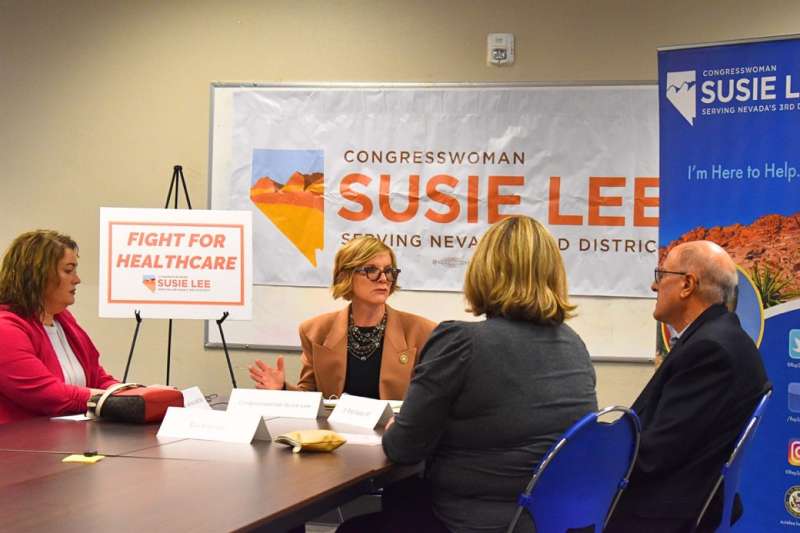
“The team that she has and that we fought so hard for right now is just rocking with her,” Eriksson, who herself is on Medicaid and has disabilities, said at a health care roundtable hosted by US Rep. Susie Lee (D-Las Vegas) inside the Desert Breeze Community Center on Thursday. “She’s just learning and improving every day.”
But Eriksson, a developmental disabilities advocate, fears Evelyn could regress in the future if she loses that coverage, or if the services covered are reduced, amid $1 trillion in looming Republican cuts to Medicaid.
“It’s difficult for me to even talk about or to even imagine what our lives would be like and for other families also affected by developmental disabilities,” Eriksson said. “They want to take that away—not just from me, but so many families in Southern Nevada are struggling with this and [who] can’t even get diagnosed, can’t even get the little bit of therapy that we have, has changed my daughter’s life and has changed how much we can be included in the community.”
Katie Provost, a Las Vegas-based social worker, was also present at the roundtable. She has sole custody of her daughter, but is worried that could change if she can’t afford health care; maintaining coverage is a requirement of her parental arrangement.
Provost, a self-employed outpatient contractor, pays $85 a month for health care, but could see her premiums increase to as high as $700 if Affordable Care Act (ACA) tax credits expire at the end of this year.
These concerns are at the heart of the ongoing federal government shutdown.
Republicans control the White House, US House, and US Senate. But because they need at least seven Democratic votes to clear the 60-vote threshold and pass a spending bill in the Senate, Democrats have pushed for an extension of these tax credits in return for their votes.
Republicans have refused to negotiate on the tax credits, which nearly 95,000 Nevadans rely on to make their premiums affordable. On average, these individuals receive $465 a month in subsidies to help lower the cost of their health insurance.
This led to a standoff, resulting in a government shutdown beginning on Oct. 1.
If the tax credits are allowed to expire, thousands of Nevadans are expected to lose their coverage, while even more could see their premiums double or even triple.
Brad Isaacs, a doctor and president of the Clark County Medical Society, is concerned about the broader community’s health care access if the subsidies end this year. He warns that a rise in uninsured medical treatments would disproportionately affect emergency rooms, potentially leading to their closure.
“How much do you have to hurt your population before it gets fixed?” Isaacs asked.
Rep. Lee also emphasized the importance of Congress extending the subsidies and protecting health care access.
“When these tax credits expire, these enrollees are going to have to pay $335 billion higher premiums over the next 10 years,” Lee said. “An average family of four will expect to see their health insurance costs increase by $4,000 a year.”
Democrats are also calling for the reversal of the $1 trillion in Medicaid cuts passed earlier this year as part of President Trump’s “One Big Beautiful Bill Act.”
More than 700,000 Nevadans receive health care coverage through Medicaid, and approximately 83,000 of them are expected to lose coverage over the next decade as a result of the cuts, according to a KFF analysis of Congressional Budget Office data.
“It’s a worsening of people’s lives,” Isaacs said of the health care cuts, “When an investment in the lives of your populace is much cheaper preventively.”
While Democrats on Capitol Hill advocate for health care subsidies and Medicaid, Isaacs cautioned that focusing solely on these two issues will not resolve the larger problems within Nevada’s health care system. He also warned about the cost of education, calling for increased access to student loans for medical students.
He further highlighted how the “incredibly wealthy” health care industry mainly benefits ancillary sectors such as health insurance, pharmaceuticals, and medical devices.
In the immediate term, however, it’s the looming loss of Affordable Care Act subsidies and cuts to Medicaid that are causing alarm about Nevadans’ ability to access care.
“The idea of losing those therapists that are a lifeline, who have opened up this dark tunnel that my daughter was in…the idea that we could lose that is difficult to talk about,” Eriksson said.